


- Featured
B2B Edition
Advanced B2B features for enterprise plans.Catalyst
NewCreate stunning, high-performing storefronts that captivate and convert.Feedonomics
Omnichannel feed and data transformation.Multi-Storefront
Manage multiple unique stores from one account.International
Grow your brand across the globe.

- Launch Services
Overview
Chart your path to success with specialised services.Implementation Project Management
Experts to ensure you launch on time and under budget.Solution Architecture
Seasoned advisors to help you best design your store.Data Migration & Optimisation
Expertise on a clean and clear path to migrating your data.Enterprise Launch Package
Personal training on how to set up and launch your BigCommerce Store.

Professional Services Blog Series
Get to know our teams and how they support your success in this Q&A series.

The Global B2B Buyer Behavior Report
This in-depth report provides actionable strategies to help you sell more online.
Explore the
BigCommerce platform
Get a demo of our platform to see if we’re the right fit for your business.
Not ready for a demo? Start a free trial
Is Ecommerce Ready for AI? 15 Ecommerce Leaders Weigh In on AI in 2026

Written by
John Shieldsmith20/03/2026

Key highlights:
AI is considered strategically important, but most organisations remain in intermediate stages of maturity and have not embedded AI as core infrastructure.
Product discovery, search, and personalisation are the top investment priorities, with teams focusing on revenue-impacting use cases.
General-purpose AI tools dominate usage, while ecommerce-native AI platforms are still in earlier stages of adoption.
Regardless of business size, most ecommerce leaders are learning about AI through word of mouth, blogs, and webinars.
AI in ecommerce is increasingly common and no longer a unique business feature. Mastering it now is the key to staying competitive in the future.
Artificial intelligence has quickly gone from niche study to infamous homework assistant to a part of daily life for many people. It was only a matter of time until AI became a primary focus for ecommerce. For good reason, too.
It’s predicted U.S. consumers will make $20 billion in ecommerce sales through AI platforms in 2026, reaching $144 billion by 2029. For ecommerce businesses, that’s a lot of money to leave on the table.
To get a better look at how businesses are preparing for this shift, we commissioned a pulse survey to find out.
Survey methodology
We surveyed a total of 15 business leaders in the ecommerce space, receiving both quantitative and qualitative responses.
Company size breakdown:
40% Small businesses (10–49 employees)
40% Medium businesses (50–199 employees)
20% Mid-market companies (200–999 employees)
Numerous industries were represented in our survey size, including ecommerce retail, apparel fashion, food & beverage, manufacturing, printing, non-profits, and education management.
The group reflects primarily SMB and lower mid-market ecommerce operators.
Key insights from 15 ecommerce leaders
Each of the leaders we spoke to plays a significant role in shaping the overall ecommerce sector. And, while some responses were expected, a number of surprising insights jumped out.
1. AI use in ecommerce is a mixed bag.
Key takeaway:
73% of ecommerce businesses surveyed are already using AI across more than one ecommerce function — signalling that AI adoption has moved well beyond the experimentation phase for most respondents.
First and foremost, it was important we learnt how ecommerce businesses are using this technology today.
When asked, “How is your business currently using AI today?” responses pointed at a mixed use of the technology.
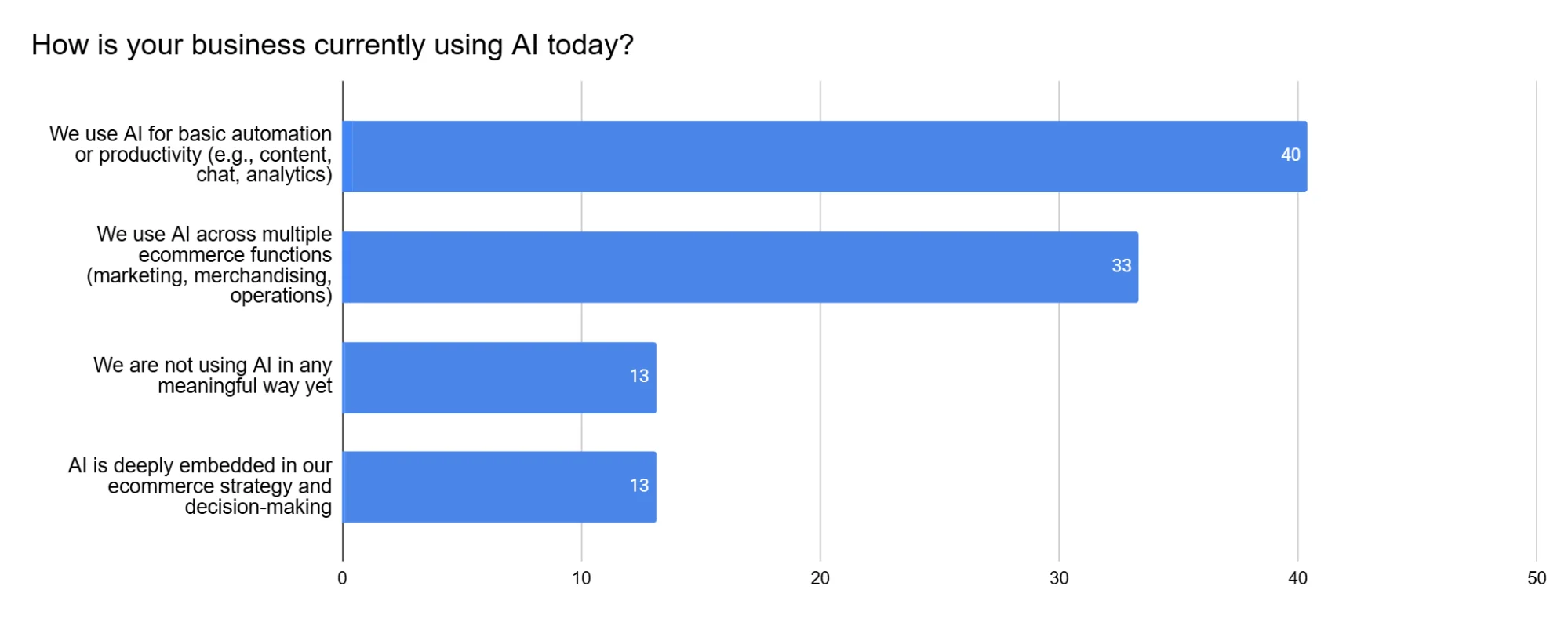
Because most ecommerce businesses are using AI to some degree, consider using it for basic productivity automation at the least. Otherwise, you risk no longer staying competitive.
2. Interest in AI is high across the board.
Key takeaway:
93% of respondents identified product discovery, search, and recommendations as a top AI priority for ecommerce — making it the most in-demand use case by a significant margin among those surveyed.
Next, we asked, “Which areas of AI are you most interested in exploring further? (Check all that apply)” and discovered there’s a general interest in most ecommerce functionality.
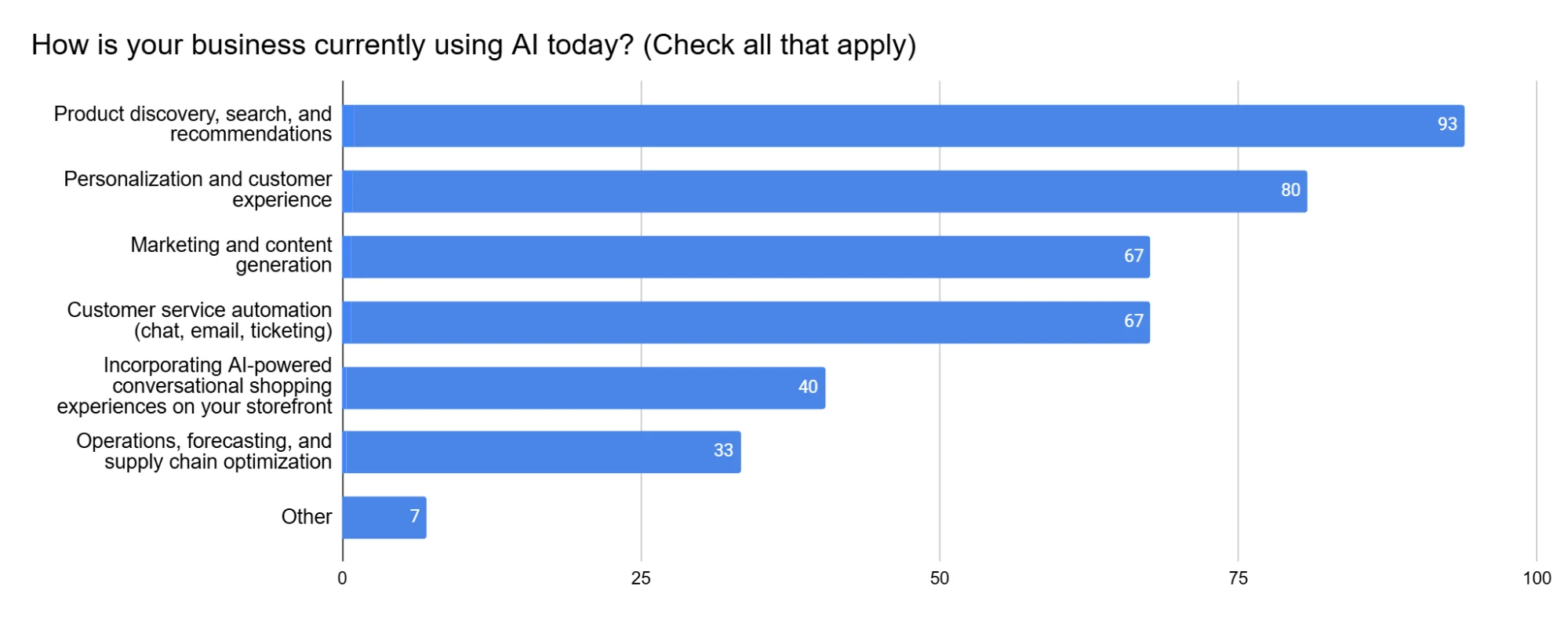
The diverse interest in AI-powered features across the board, along with a rise in adoption rates, shows AI in ecommerce is just getting started. If you aren’t exploring it already, this is your sign.
3. General-purpose GenAI tools are the popular choice in ecommerce.
Key takeaway:
73% of ecommerce leaders are using general-purpose GenAI tools, while only 33% are exploring AI-powered forecasting and analytics.
Ecommerce businesses are pursuing AI. But, are they using ecommerce-specific tools?
To find out, we asked, “Which AI tools does your business use most frequently? (Check all that apply)” and found that general-purpose GenAI is still number one, but ecommerce AI tools are already nearing 50%.
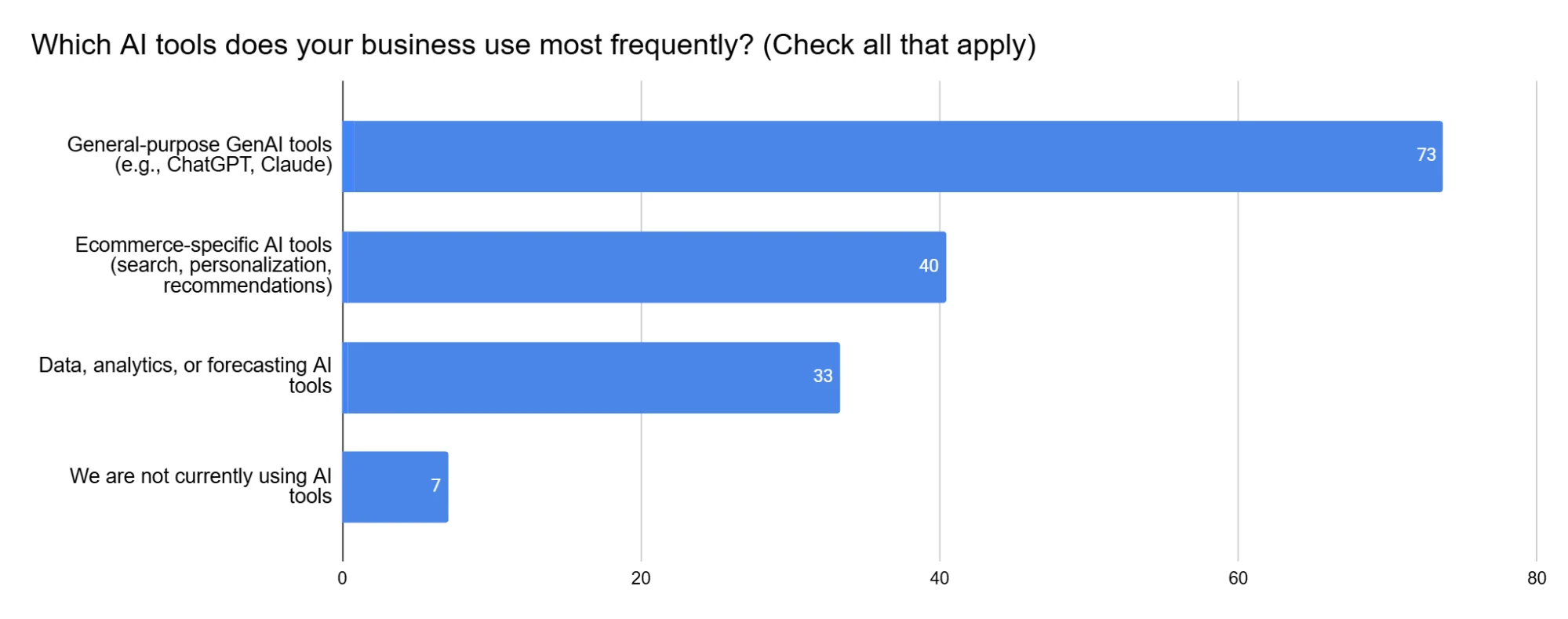
General-purpose and ecommerce AI are the top two use cases, showing a clear demand for personalisation, broad AI support, and analytics. Instead of looking for this functionality across a number of tools, simplify your stack and find an ecommerce platform with AI support that checks all these boxes.
4. The majority of ecommerce businesses aren't AI experts — yet.
Key takeaway:
80% of surveyed ecommerce leaders feel their organisation is above beginner level AI expertise, while none list AI as a core organisational capability.
A majority of ecommerce businesses are using AI, with interest in further exploration. Yet, when asked, “How would you rate your organisation's skill level with AI tools?” it became clear many don’t consider themselves experts.
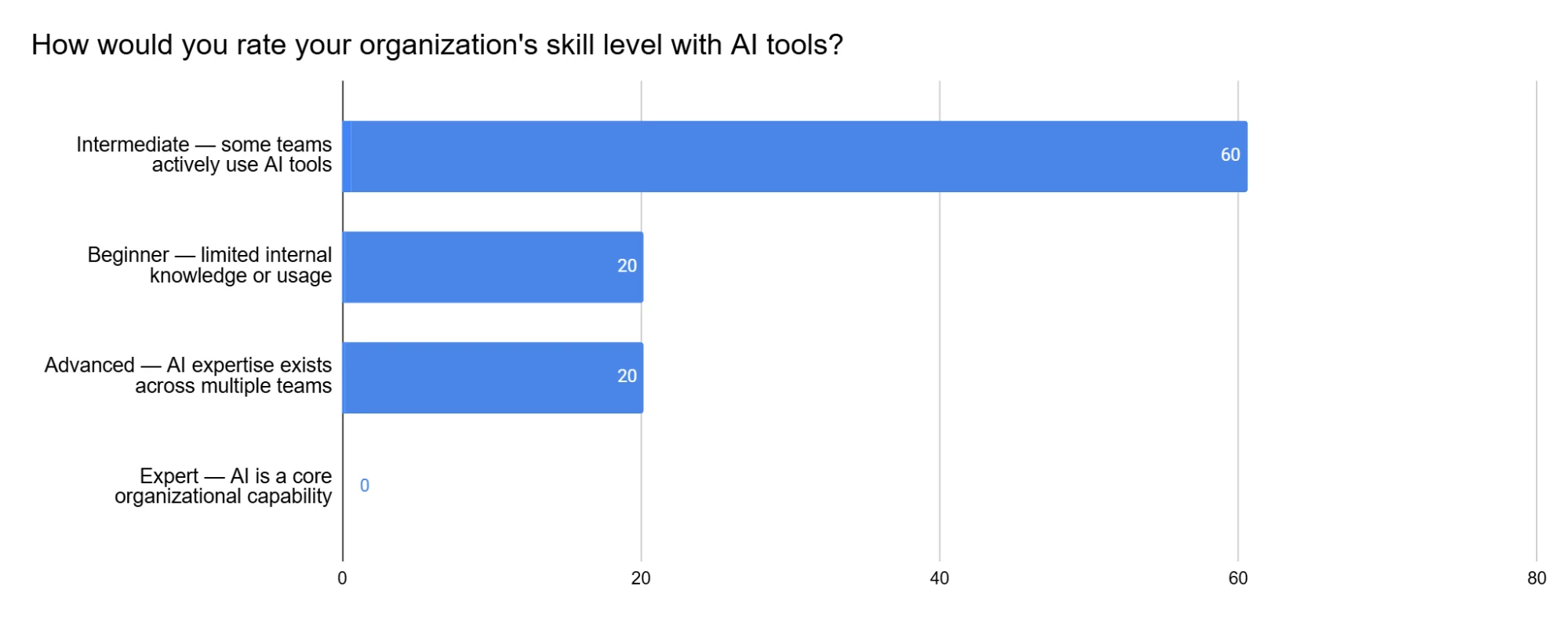
Nobody in ecommerce is claiming to be an AI expert, so don’t stress if you don’t feel like one either. Focus on exploration and education, prioritising responsible use of AI at every step.
5. 93% of ecommerce businesses agree: AI is important.
Key takeaway:
93% of leaders surveyed see AI having a role in the future success of their ecommerce business, with 67% saying it’s “very important” to staying competitive.
When asked, “How important is AI to the future success of your ecommerce business?” only 7% of respondents said AI wasn’t important at this time. To the rest, AI can’t be ignored, especially if you want to stay competitive.
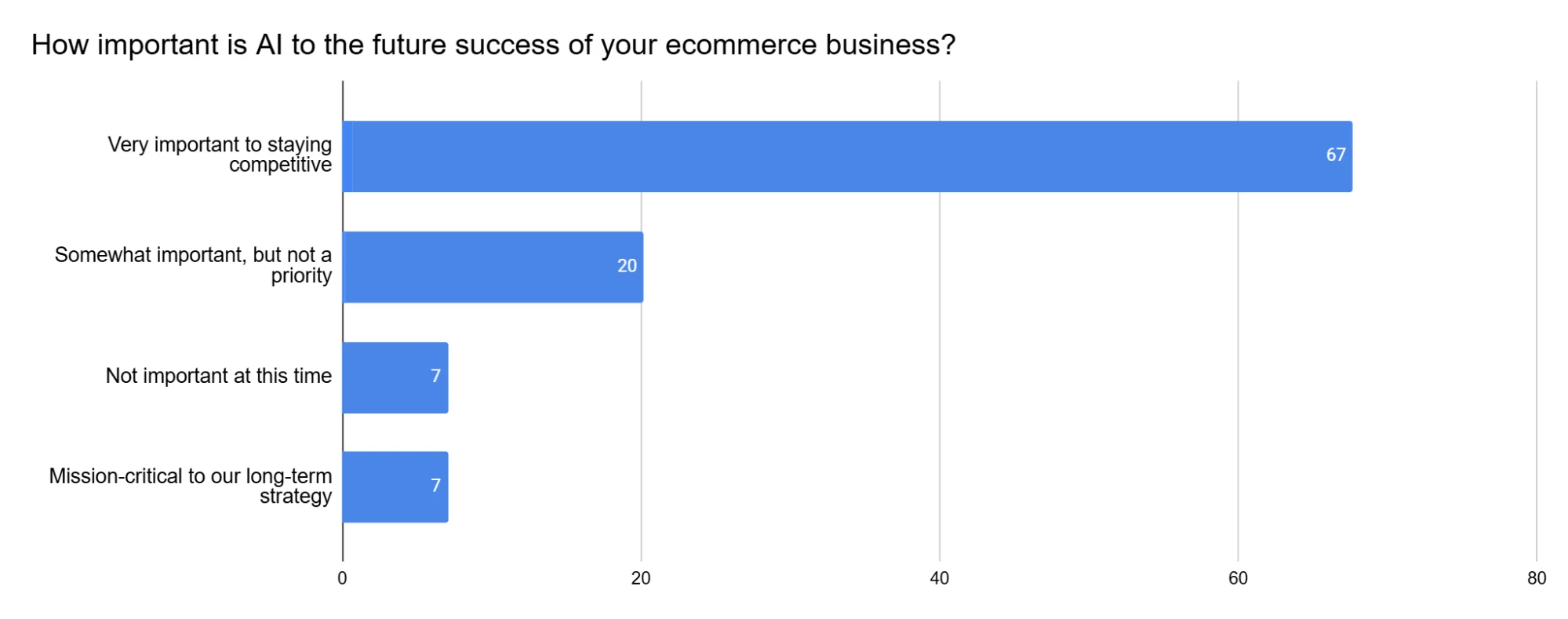
The majority of ecommerce businesses see AI as a must in order to stay competitive. As more and more businesses engage with AI, and AI grows in accessibility, AI will be less of a niche add-on and table stakes for those wanting to compete in their market
6. Customer trust and brand reputation are top concerns for AI users.
Key takeaway:
87% of ecommerce leaders agree — brand risk and customer trust are the biggest risks with using AI, followed closely by accuracy and reliability of AI outputs.
Nothing is without risk, and that includes the use of AI in ecommerce.
We asked, “What concerns does your organisation have about scaling AI in ecommerce? (Check all that apply).”
While a few were close in the number of votes, it’s clear ecommerce businesses are most concerned about damaging their brand by way of AI use.
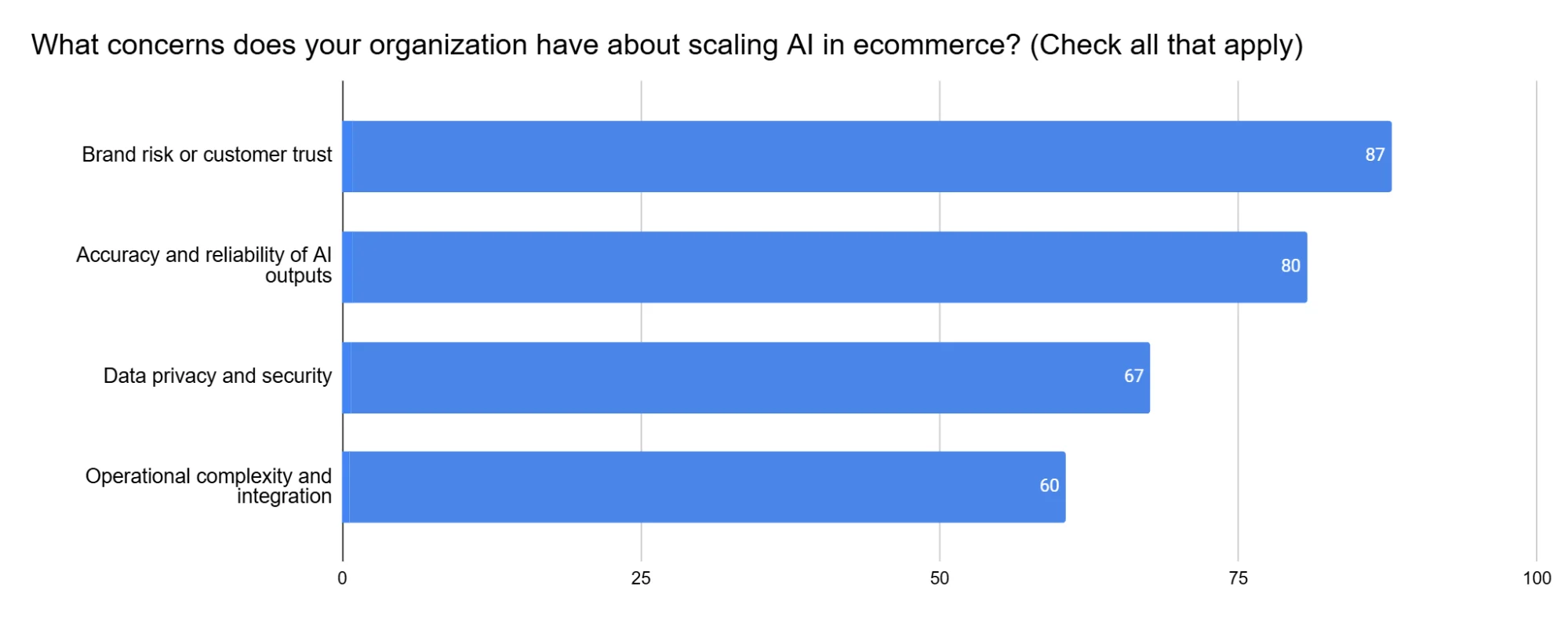
With 50% of adults in the U.S. “more concerned than excited” about the increased use of AI, brands worrying about customer trust and reputational damage are justified. While the use of AI will likely increase in ecommerce, don’t rush in without a plan. Expand your AI use cases slowly, and always practise transparency, letting your customers know how their data is used
7. Every business is keeping a human in the loop.
Key takeaway:
Human oversight with AI use is a must, with 100% of ecommerce business leaders having at least some degree of human in the loop
Streamlining productivity and saving time are two of the benefits often touted by AI, and a key reason many ecommerce businesses embrace the technology. But, none of our survey respondents are letting it drive the car on its own.
This point was made clear when asked, “How important is human oversight in AI-driven commerce decisions today?”
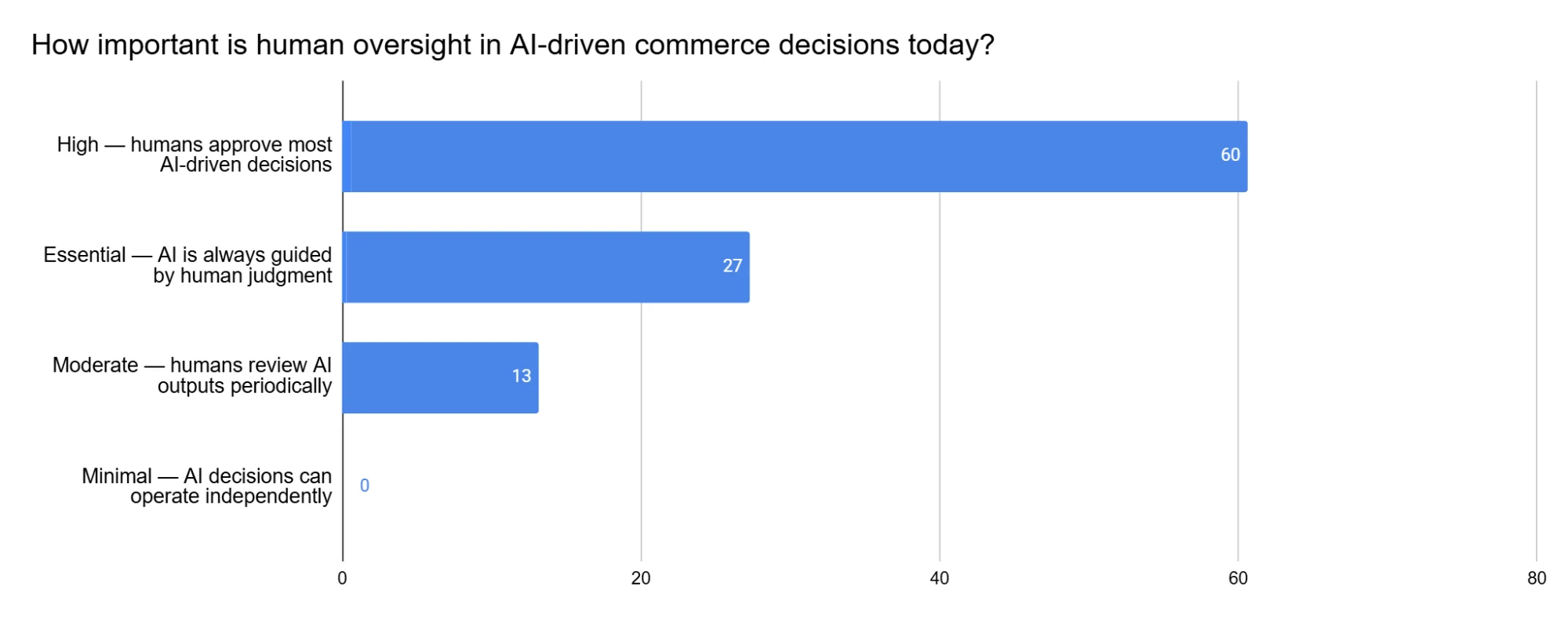
Between public concerns around AI and business worries of brand and trust, hesitancy around AI is understandable. Safe use of AI is possible, but only when you’re ensuring a human is always involved in the process, as made clear by the 15 ecommerce leaders surveyed..
8. Not a single brand reported fully AEO-optimised product pages.
Key takeaway:
40% of ecommerce businesses surveyed said they’re in the process of standardising product pages for agentic AI, while 33% have yet to start. None of the leaders surveyed say their product data is fully optimised for AI-driven discovery.
Answer engine optimisation (AEO) is increasingly important, as it increases the chances your pages are surfaced by any number of AI answer engines, including AI-powered agents, or agentic AI. While agentic AI can help your ecommerce business be more efficient, it can only do so if your product pages are ready for them.
We asked, “As AI agents increasingly act on behalf of shoppers, how are you preparing your product data for machine-readable discovery (AEO)?” and quickly learned that nobody feels their entire product catalogue is 100% AI-ready.
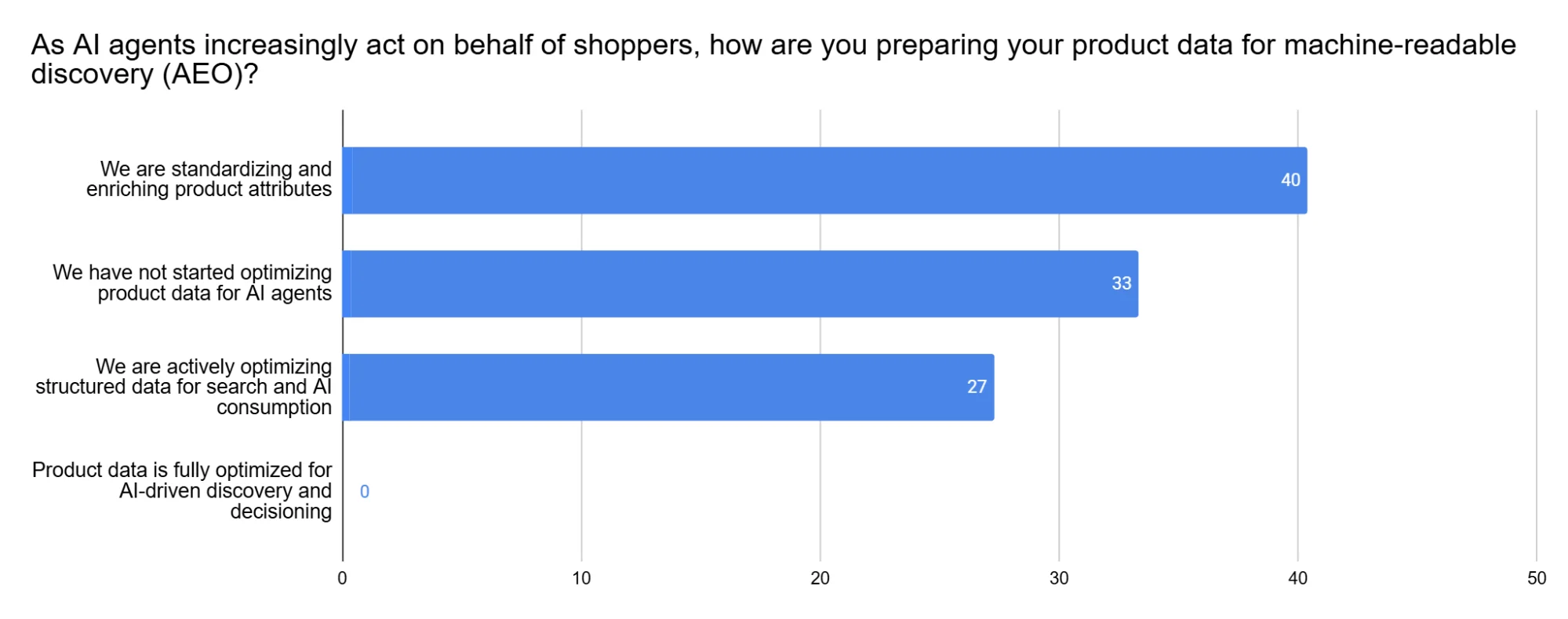
Not one of our respondents said their entire product catalogue is optimised for agentic AI or answer engines. With AI use in ecommerce increasingly common, prioritising AEO for your product pages before your competitors do so can give you an advantage.
Discover How AI is Transforming the Customer Experience
AI is quickly reshaping the landscape of ecommerce. Learn how you can prepare for the next wave of AI commerce.
9. Business leaders don’t expect AI agents to become a primary sales channel.
Key takeaway:
No ecommerce business leaders surveyed see a future where AI agents are the primary way customers shop, while 47% see agentic AI-led shopping applying only to low-risk purchases.
None of the respondents felt their product pages were ready for AI primetime. Similarly, when asked, “How do you expect customers to adopt AI agents that shop or make purchasing decisions on their behalf?” respondents firmly agreed that AI agents would not become the primary way customers shop.
This could be the case. But, is this also influenced by a lack of AI readiness across product pages?
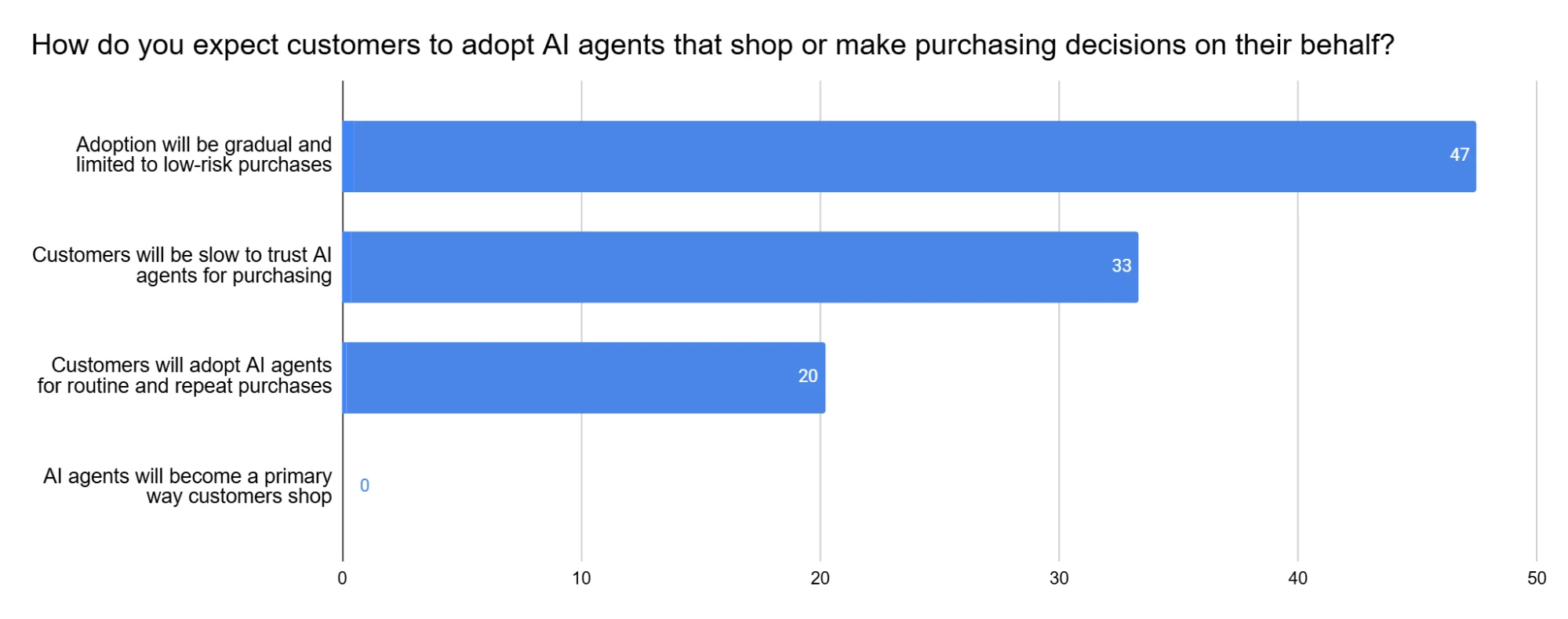
This clearly reinforces that you shouldn’t expect AI agents to act as a primary sales channel. Instead, incorporate them into your existing sales funnel, allowing them to help with less complex sales and challenges, while not relying on them too heavily.
10. Agent-to-agent commerce isn't happening anytime soon.
Key takeaway:
47% of ecommerce business leaders haven’t considered agentic commerce workflows, 53% are in the early stages or actively prepping, and no businesses surveyed say they’re fully prepared.
The concept of agent-to-agent commerce is incredibly new, and imagines a world where a customer can request a service or product from one agent, which then completes their order with another from another brand.
Unsurprisingly, when asked, “How prepared is your ecommerce organisation for agentic commerce workflows (agent-to-agent transactions)?” none of the respondents claimed to be fully prepared.
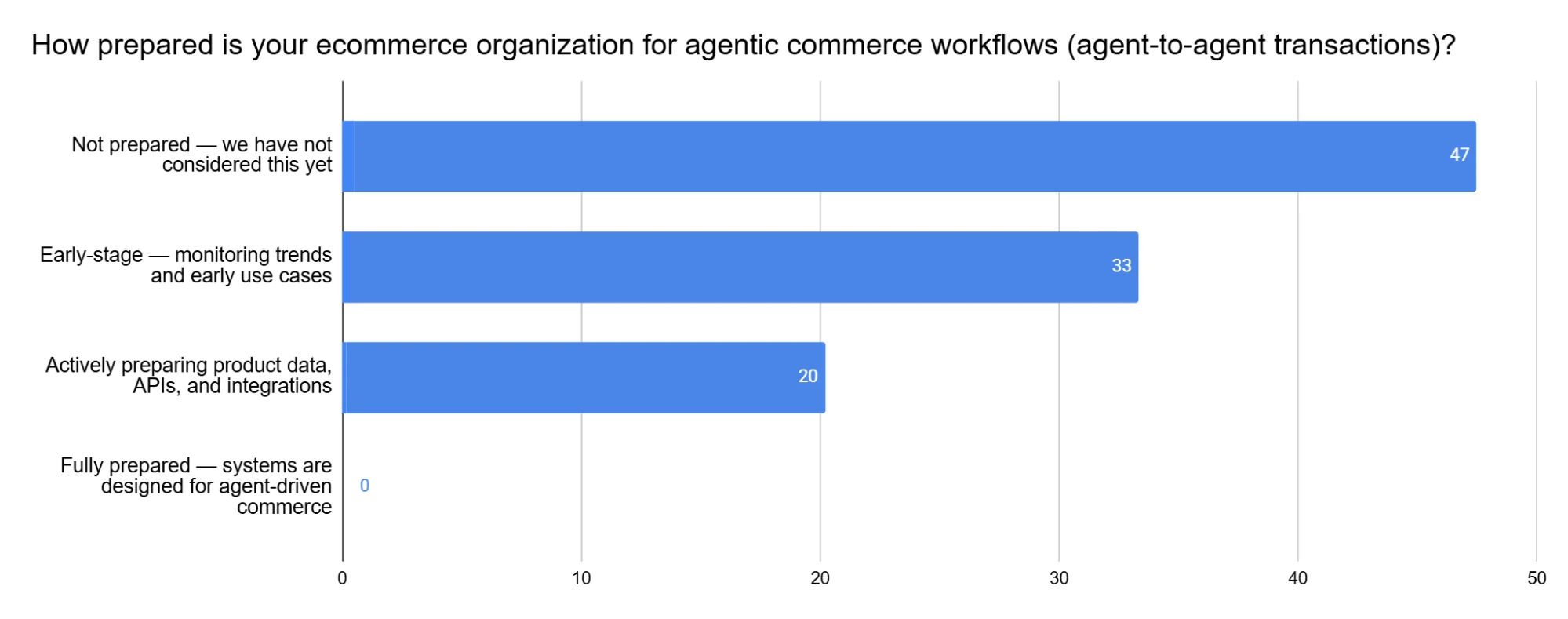
Agent-to-agent transactions are likely a long way off. Instead, focus resources on ensuring your product pages are ready for your brand’s agentic AI, streamlining internal workflows where you can.
11. More than half of ecommerce leaders report a hit to SEO traffic.
Key takeaway:
67% of surveyed ecommerce business leaders report a loss in SEO traffic and have begun optimising for AEO/GEO, while 33% have no AEO/GEO strategy in place yet.
With the rise of AI-powered search, search engine optimisation (SEO) efforts haven’t yielded the same fruit as before. For many websites, this has led to a noticeable dip in traffic. But, has it impacted ecommerce businesses in a similar manner?
We asked, “Have you seen changes in organic search traffic, and how are you adapting to AEO/GEO strategies?” to find out, and discovered most businesses have noticed an impact and are taking some effort to course correct.
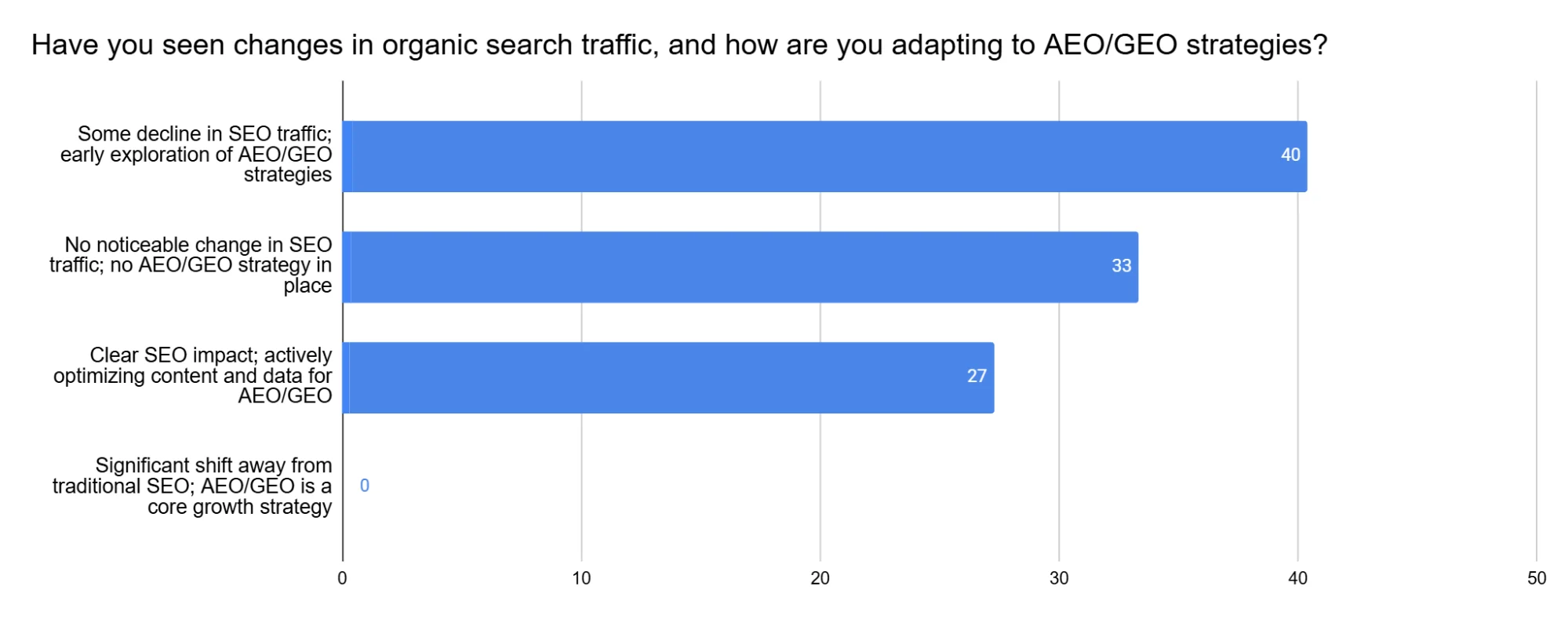
Most businesses have felt the SEO shift and are exploring or actively engaging in AEO and generative engine optimisation (GEO) efforts. Even if your business hasn’t taken an SEO hit, your competitors are likely practising AEO/GEO and you should too.
12. Personalisation is paramount in 2026.
Key takeaway:
73% of ecommerce business leaders say AI-powered personalisation is the top shopper-facing use of AI, followed closely by AI-powered conversational shopping experiences at 67%.
The practise of personalisation has been a focus of ecommerce for years now, and it’s only gaining steam: 73% of shoppers expect more personalisation today.
This is an area where AI can make a difference, allowing faster and more accurate personalisation across marketing, sales, and product recommendations.
The ecommerce leaders we surveyed agreed, when asked, “Which shopper-facing AI use cases matter most to your business? (Check all that apply)”
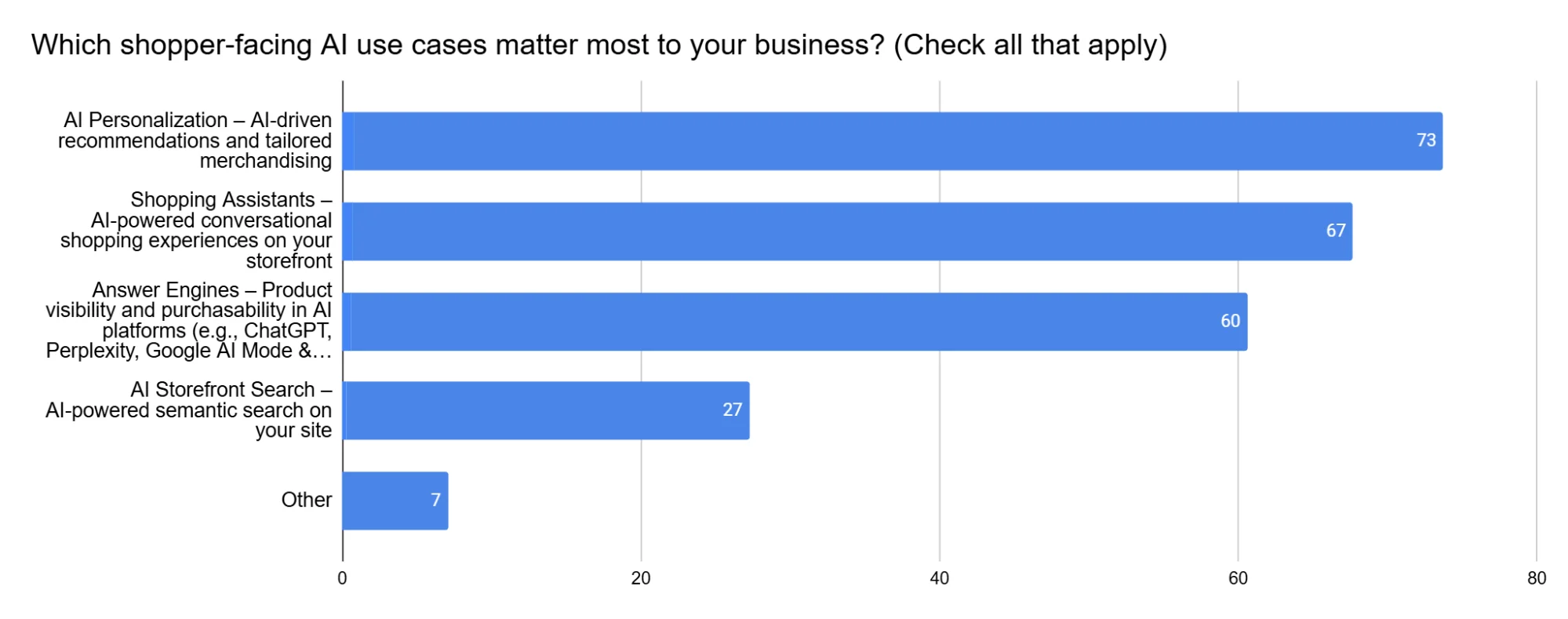
A more personalised shopping experience is a must. But, don’t ignore other competitive uses of shopper-facing AI, like delivering a conversational shopping experience, working to get products surfaced in answer engines, and enabling AI-powered product searches.
13. ChatGPT wins the popularity contest.
Key takeaway:
40% of ecommerce leaders agree that ChatGPT is “very important” to their business, with Claude and Google AI Mode & Gemini sharing second place at 20% each.
The number of answer engines available continues to grow, with names like Claude and Gemini and CoPilot joining ChatGPT.
Despite this, after asking, “Which Answer Engines are most important to your business today?” it was clear: ChatGPT is still the main focus, with the most replies at “Very Important.”
It’s worth noting that in the “Important” category, Google AI Mode and Gemini were the top choice, sitting at 40%. With Gemini available by default on many Android phones, it’s an incredibly accessible answer engine for many.
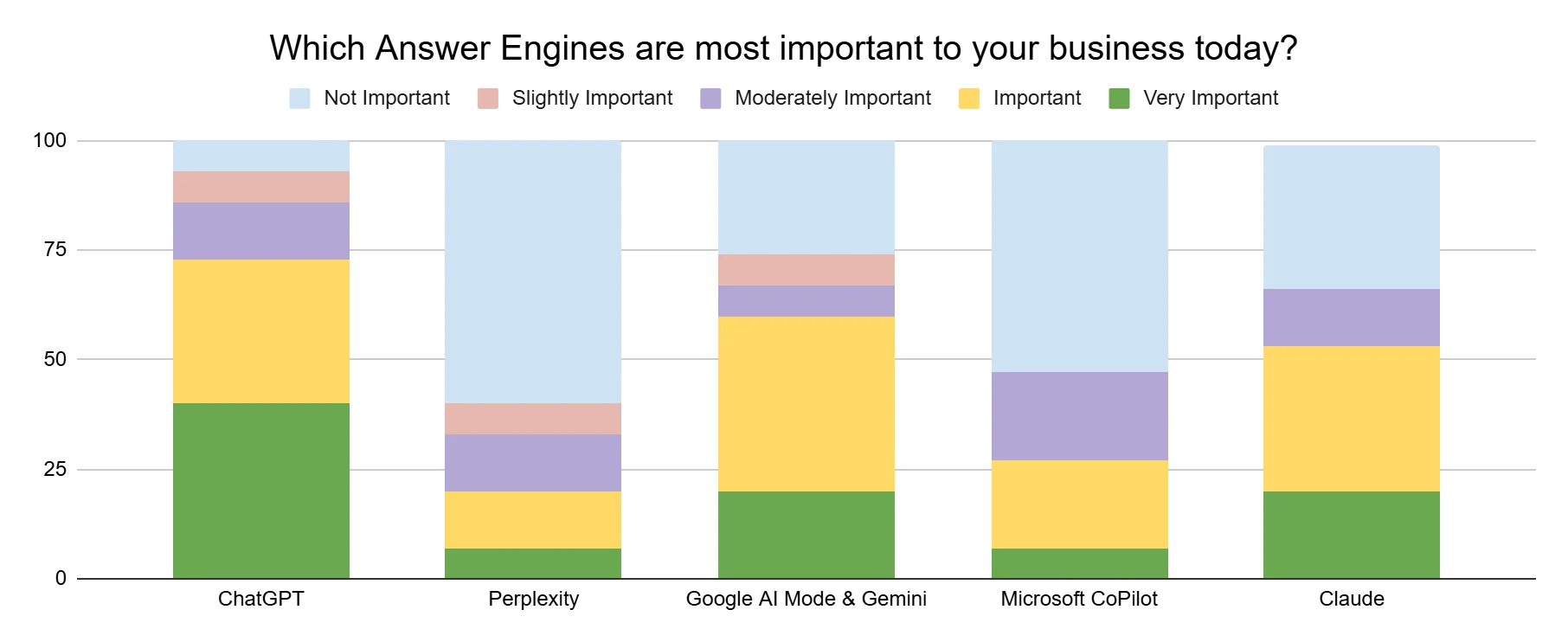
ChatGPT, Google AI Mode and Gemini, and Claude are the most important answer engines for ecommerce businesses. If you’re going to focus on any, spend your resources wisely and prioritise these three.
14. Blogs and word of mouth are top ways to learn about AI.
Key takeaway:
When asked about how they grow their knowledge of AI in ecommerce, business leaders — regardless of organisation size — most frequently cited blogs and newsletters, followed by word of mouth.
As it exists today, AI hasn’t been around for more than a handful of years. (Remember: None of the ecommerce brands surveyed think of themselves as complete experts.)
This made us curious: “How do you currently grow your knowledge of AI in ecommerce and its practical applications?”
We asked for qualitative rather than quantitative answers, receiving detailed replies. While some mentioned vendor audits or in-person events, a few resources cropped up across the board:
Blogs and newsletters were the most common replies, whether respondents mentioned seeking them out intentionally or coming across them organically on LinkedIn.
Word of mouth was also a top source, with nearly every respondent mentioning they often learn of new AI strategies or developments from other people in their circle or industry.
Webinars were also frequently mentioned, especially when offered by AI vendors or consultants in the space.
Everyone still has a lot to learn and many people are excited to share, whether on LinkedIn or via blog or newsletter. No matter the original source of the information, word of mouth was a common thread. Listen to your peers, see what your competitors are doing, and keep in mind everyone is still figuring it out.
The final word
The next few years are sure to see AI growing and shifting in its capabilities and uses, especially in the ecommerce sphere. Whether agent-to-agent commerce takes off or SEO finds its place again, it’s difficult to say.
Regardless, one thing is clear: AI is quickly becoming table stakes, and being competitive means being able to adapt.
With the BigCommerce platform, you can build your business with an agile, customisable foundation that’s equipped to handle AI at every step, via BigAI. With integrations that can help you:
Create AI-ready product descriptions.
Recommend products to customers based on shopping habits.
Predict the future lifetime value of customers.
Drive accurate product categorisation through Feedonomics.
See for yourself how BigCommerce can help you streamline the increasingly omnichannel world of ecommerce, while enabling you to dream big and achieve even bigger. Sign up for a demo today.
There's a lot to love ❤️
Watch a demo to see the BigCommerce platform in action.