


- Featured
B2B Edition
Advanced B2B features for enterprise plans.Catalyst
NewCreate stunning, high-performing storefronts that captivate and convert.Feedonomics
Omnichannel feed and data transformation.Multi-Storefront
Manage multiple unique stores from one account.International
Grow your brand across the globe.
- Launch Services
Overview
Chart your path to success with specialised services.Implementation Project Management
Experts to ensure you launch on time and under budget.Solution Architecture
Seasoned advisors to help you best design your store.Data Migration & Optimisation
Expertise on a clean and clear path to migrating your data.Enterprise Launch Package
Personal training on how to set up and launch your BigCommerce Store.
Professional Services Blog Series
Get to know our teams and how they support your success in this Q&A series.

The Global B2B Buyer Behavior Report
This in-depth report provides actionable strategies to help you sell more online.
Explore the
BigCommerce platform
Get a demo of our platform to see if we’re the right fit for your business.
Not ready for a demo? Start a free trial
Breaking Free from SAP Hybris: Modernising Commerce at Scale with BigCommerce

Written by
Ramanathan Ramakrishnamurthy18/03/2026
Breaking Free from SAP Hybris: Modernising Commerce at Scale with BigCommerce
Get The Print Version
Tired of scrolling? Download a PDF version for easier offline reading and sharing with coworkers.
A link to download the PDF will arrive in your inbox shortly.
Key highlights:
SAP Hybris often becomes a constraint at scale, with rising maintenance costs, slow release cycles, and heavy customisation limiting innovation and business agility.
Modern SaaS platforms like BigCommerce shift operational responsibility, offloading infrastructure and upgrades while requiring stronger focus on integrations, APIs, and governance.
Migration is a business transformation — not just a technical move, impacting cost structure, risk, scalability, and speed to market.
Success depends on disciplined planning and simplification, including clear goals, discovery, data strategy, integration design, and rationalising unnecessary customisations.
The real value comes post-migration, where continuous optimisation (performance, conversion, and experience) turns platform stability into measurable growth.
When maintenance starts dictating your roadmap, your platform is no longer an asset — it’s a constraint. What was once built to enable innovation begins consuming the very resources meant to drive it.
That is when the question shifts. Instead of asking, “Does the platform still run?” leaders begin asking, “Does the platform still create measurable business value?”
Most organisations adopted SAP Hybris (now SAP Commerce Cloud) for its control, flexibility, and deep customisation capabilities. For years, that investment made strategic sense. It provided the architectural freedom enterprises needed at a time when commerce complexity demanded it. But as customer expectations, release cycles, and cloud-native alternatives have evolved, the operational weight of that flexibility has become harder to ignore.
Worldwide end-user spending on public cloud services grew by more than 20% in 2024, reaching approximately $675 billion — reflecting the continued shift from on-premises systems to cloud-based models.
The shift to cloud-first commerce is not just about modernisation. It is about operational leverage. Leaders are increasingly questioning whether a heavily customised, self-managed platform still justifies its total cost of ownership — or whether it quietly slows innovation.
Moving to SaaS does not make enterprise commerce simpler. It changes where complexity lives. Infrastructure and upgrade risk move to the vendor. Integration design, API governance, and architectural discipline move to the enterprise. SaaS reallocates responsibility. It shifts risk boundaries. It changes governance models. Leaders must understand this shift before migration begins.
This migration has implications that go beyond your code. It affects cost structures, risk exposure, release velocity, and long-term scalability. It is not only about moving faster. It is about designing a model that protects revenue while enabling growth.
Independent Total Economic Impact™ studies of modern SaaS commerce platforms have shown returns exceeding 200%, with payback periods often under 12 months — reinforcing the financial case behind architectural change.
Against this backdrop, many enterprise brands are evaluating platforms such as BigCommerce as part of a broader architectural reset. Switching from SAP Hybris to BigCommerce is increasingly seen not as a trend but as a structural modernisation decision — one that reshapes operational responsibilities and long-term risk.
This guide will help you determine when to migrate, how Hybris and BigCommerce differ, and why these differences matter to your business.
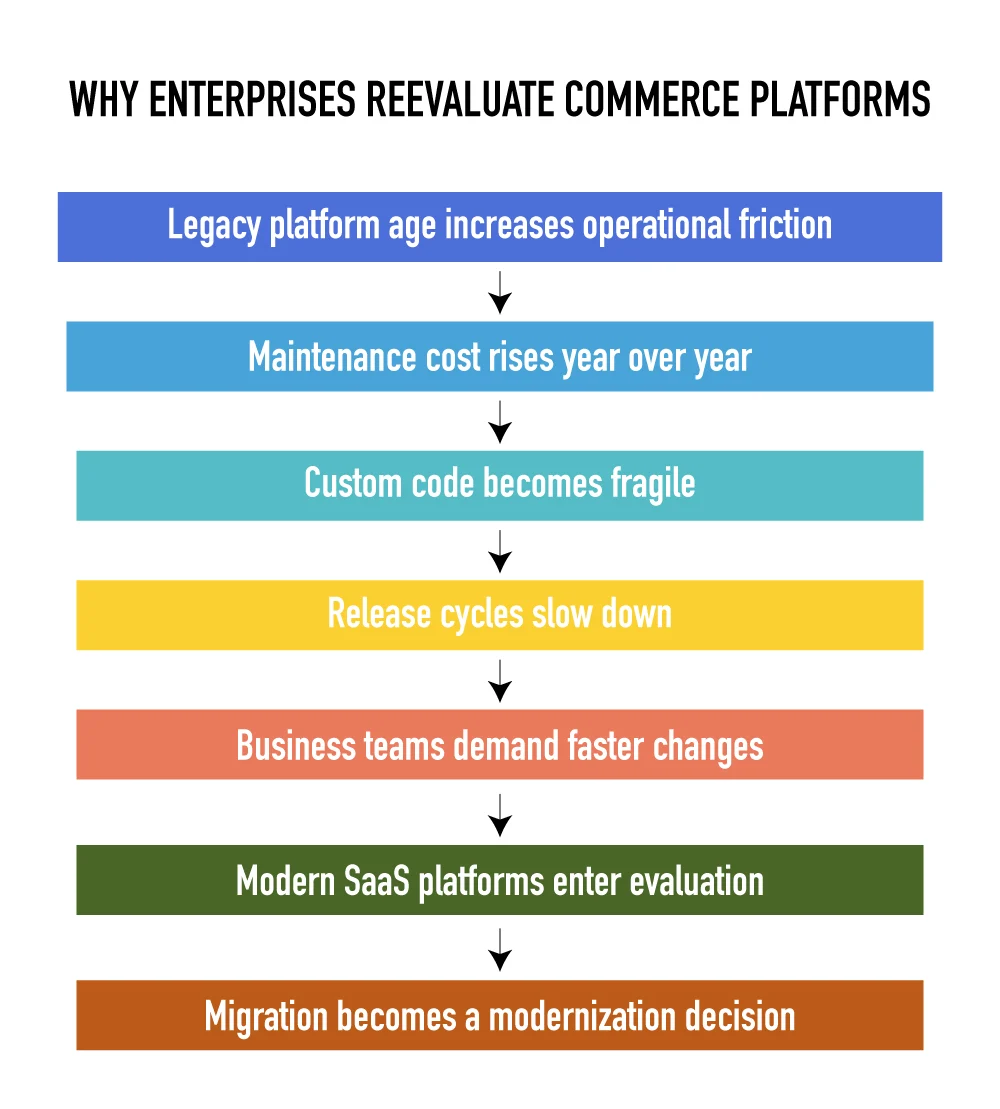
When does SAP Hybris start holding you back?
A migration becomes necessary when the effort to maintain your platform starts to impede your business more than it helps.
You may observe this through rising costs, slower updates, and heightened operational risks.
Long-running Hybris setups tend to get more complicated over time. Custom add-ons increase, and the technical setup gets harder to manage.
Typical pain points include:
Large engineering effort for routine changes
Risky and infrequent upgrades
Growing dependence on specialised skills
Maintenance begins to take over the plans. Teams spend more time keeping operations running than improving the customer experience. Growth makes these problems worse. New geos, brands, and markets put more pressure on the platform. Optimisation becomes the new normal. Scaling requires planning rather than automation. Peak events feel like a minefield rather than a rush.
At this point, the leaders can see the platform’s limitations. Marketing can’t get new things out the door quickly. Product groups have to cut back on some features. Experiments are delayed or cancelled.
This is usually when companies start to consider SaaS platforms. It eliminates complexity. It moves it. In reality, complexity does not disappear — it shifts from platform maintenance to integration ownership and governance discipline. The vendor now handles technical setup, system growth, and basic security. Your teams can focus on customer experience, connecting systems, and what makes your business unique.
Migration is about helping your business move forward again. Many enterprises rely on structured BigCommerce migration services to reduce disruption during platform transition.
Key takeaways:
Pain is first seen in operations, then in business velocity.
High maintenance means a lack of platform leverage.
SaaS is often considered to regain predictability.
How are Hybris and BigCommerce built differently?
Hybris is a platform you run and manage with your own code, while BigCommerce is a SaaS solution intended to work with APIs from the beginning. This affects who manages the technical setup, how you customise things, and how systems grow over time.
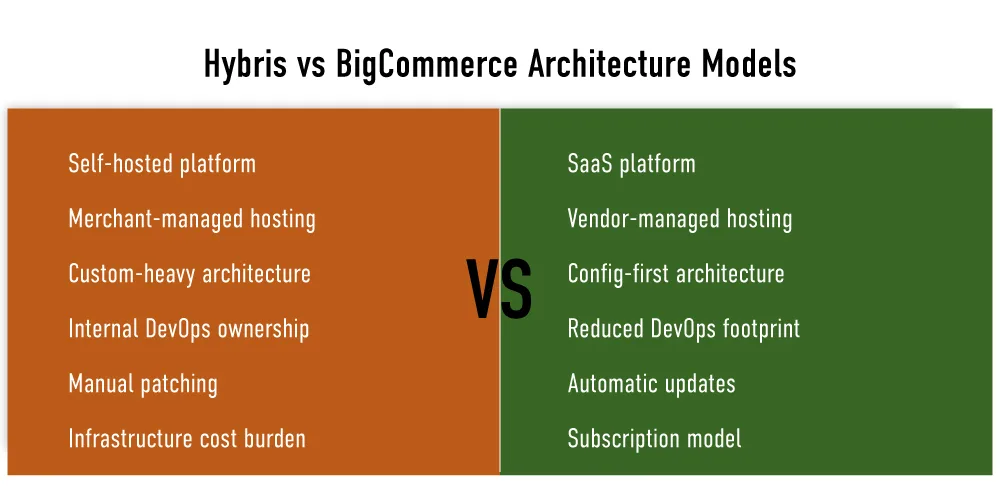
Hybris environments require internal ownership of:
Servers and databases
Scaling and performance tuning
Patching and upgrades
High-availability
BigCommerce handles these for you. The technical setup is hidden. Growing the system happens automatically. Uptime is included.
Customisation also differs.
Hybris relies on deep platform extensions written in Java. Although powerful, they can make the system harder to change.
BigCommerce encourages:
Configuration before customisation
Apps for common needs
APIs for custom services
Frontend customisation outside the core
Rather than extending the core system, teams now extend around it. Control moves from managing code inside the platform to managing services and APIs across systems. This design shift impacts how you run and manage your systems. The traditional means of managing the platform become less relevant. The key point is to ensure that the connections are good. The point of monitoring shifts from servers to services and APIs.
It is important to understand the differences early on to prevent making assumptions. Considering BigCommerce as simply a SaaS offering of Hybris can result in overly complex solutions. Adopting the SaaS approach results in simpler designs.
Key takeaways:
Self-hosted and SaaS models have different responsibility models.
Customisation shifts from core extensions to services and APIs.
Architecture awareness prevents migration overengineering.
What should migration actually achieve?
Migration goals help keep the project on track by relating business objectives to actions. They define what success looks like and what matters most. They help ensure that technical decisions provide maximum business value. Without well-defined goals, migration projects are no more than technical initiatives, not actual business changes.
Migration projects should begin with organisational aims. Common goals include minimising operating expenses, boosting site reliability, speeding up release times, and enhancing the customer experience. Business goals define the reason for the migration.
Technical goals are the next step. They must benefit the business directly. Some examples of technical goals include reducing the use of custom code, making system-to-system communication easier, and eliminating unnecessary technology expenses. Technology decisions should always benefit the business. Objectives must also account for how responsibility shifts in a SaaS model — from infrastructure oversight to ecosystem governance.
Not all goals are of equal importance. It is necessary to decide which results are most important. Each important goal should have a way to measure it. These measures show progress.
Coordination with stakeholders is very important. Commerce, IT, operations, and management must all agree early on. Scope constraints should also be documented. What will move in phase one? What will move later? What will stay behind?
What to define during objective setting:
Business goals
Supporting technical goals
Priority order of outcomes
Success metrics
In-scope and out-of-scope areas
Why discovery comes before migration
Discovery provides a factual perspective on the current environment, enabling migration planning with confidence. Discovery reveals hidden complexity and points out risk areas. Discovery helps avoid surprises that result in cost overruns and delays.
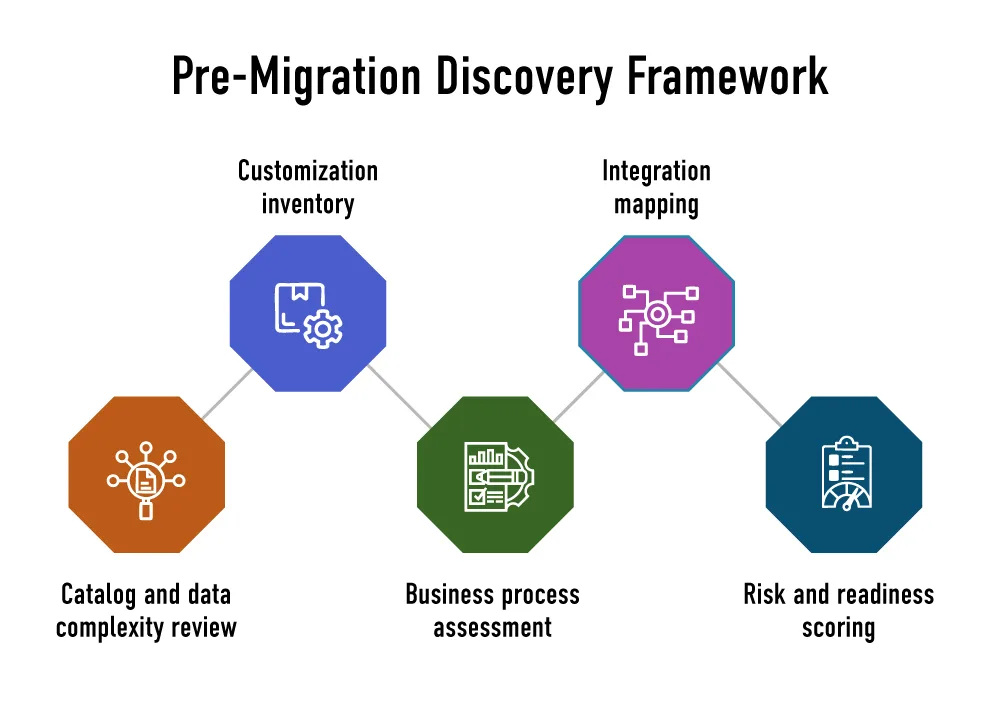
The discovery process typically starts with a catalogue analysis. The teams examine product quantities, variant levels, and category structures.
Next is a list of all custom changes. All add-ons and changes are written down. Each one is marked for removal, replacement, or rebuilding.
Next, all connections in the system are enumerated. This is for planning, customer administration, product data, order administration, payments, taxes, and marketing. Data movement and responsibility are also documented.
A readiness score is a compilation of all results. Problematic areas are highlighted. Task connections are clarified. Plans for solving problems are developed before actual work starts.
What should discovery cover?
Product catalogue complexity
Customisations and overrides
Integration landscape
Data flows and ownership
Risk and readiness scoring
What does an effective data migration strategy look like?
A good data migration plan only moves data needed for future work. It guarantees the data is correct and reduces risk during the switch. It does not bring along old, unneeded data.
Data scope is defined first. This step determines which entities — such as products, customers, orders, pricing, and content — will be migrated and which historical data will be excluded.
Next comes field mapping. Each field in the source system is matched to its corresponding field in BigCommerce. During this process, structural differences between the two platforms are identified and addressed.
Transformations are then applied where necessary. These handle format changes, normalisation, validation rules, and data cleanup to ensure that information aligns correctly with BigCommerce’s data structure and business logic.
Complex product types require different handling. Bundles, kits, and products with options may need a different setup.
Most teams do not need to move all historical data. They usually import only recent or important orders, while older records remain in an archive system.
Testing confirms that the migration was successful by validating total record counts, reviewing representative samples, and verifying data relationships.
What the data strategy must address:
Data types to migrate
Field mapping and transformation rules
Complex product structures
Historical data approach
Validation and reconciliation
Which customisations are worth keeping?
Customisation should be reviewed before moving it over. Not everything made in Hybris needs to be in the new system. Simplifying features makes things less complicated and cheaper to run over time. The goal is to keep what helps the business and eliminate unnecessary technical work.
Trying to match every feature is a common mistake. Rebuilding everything just brings the same problems into the new system. Moving to a new platform is a good time to rethink old choices.
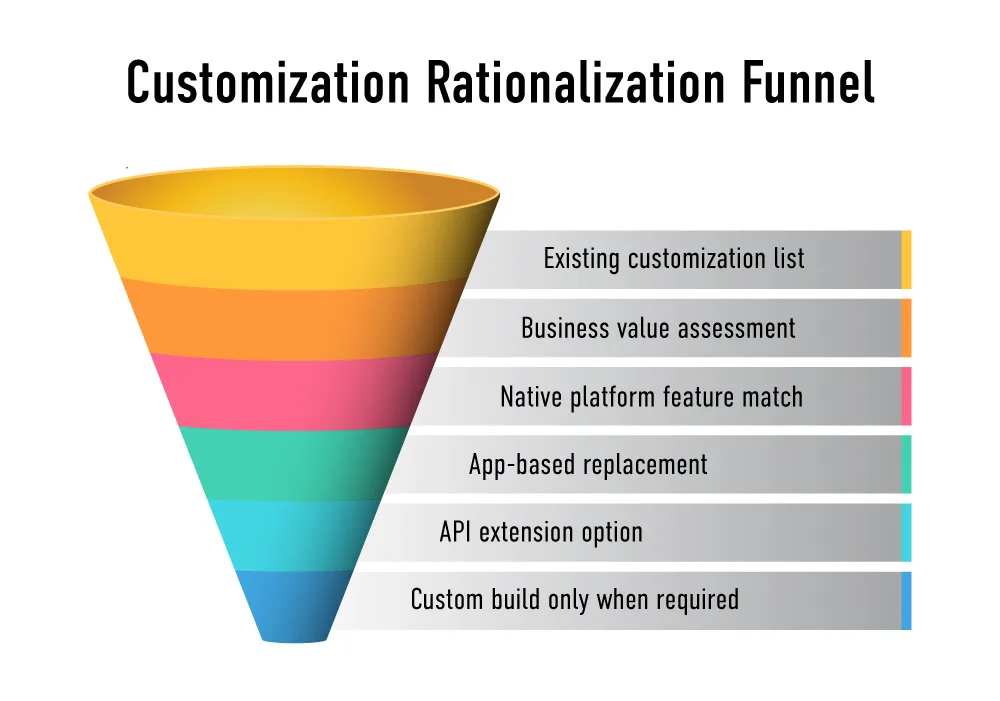
Each customisation should be reviewed for business value. Ask who uses it. Ask how often it is used. Ask what happens if it is removed.
Many features are already included in BigCommerce. Others can be swapped out for apps from the marketplace. Both choices cost less than building something new from scratch.
APIs let outside services handle more complicated tasks. This keeps the main system simple.
Custom builds should be rare. They are justified only when no native feature or app can meet a validated business need.
What to evaluate during rationalisation:
Business value of each customisation
Native BigCommerce feature fit
App availability
API based alternatives
True need for a custom build
How should integration architecture be planned?
Integration architecture defines how BigCommerce connects with enterprise systems. In a SaaS model, integration design becomes the new centre of operational complexity. A clear architecture prevents brittle point-to-point connections and supports long-term scalability.
Most ecommerce environments rely on systems such as ERP, CRM, PIM, OMS and payment providers. These integrations should be identified and mapped early in the planning process.
An API-first approach should be the standard. BigCommerce is built API-first, and the surrounding systems should be as well. When systems expose robust APIs, they integrate cleanly and remain loosely coupled.
Middleware may be appropriate when data transformation, orchestration, or monitoring requirements increase. Direct integrations can work well when data flows are straightforward and limited in scope.
Authentication and security must be standardised. Token management and rotation policies should be clearly defined.
Resilience planning is equally important. Integration design should account for failure scenarios, message logging, retry strategies, and centralised monitoring.
What integration planning must cover:
List of enterprise systems
API availability
Middleware versus direct model
Authentication approach
Error handling and monitoring
How do you protect SEO and UX?
Good SEO and a stable website look help keep sales steady during migration. If not handled well, you can lose visitors and sales. Both need to be top priorities.
SEO problems often start with web addresses. Current web addresses need to be matched up. Redirects should be set up before going live.
You need to move over all the extra information about your pages. Keep titles, descriptions, and organised data the same.
The frontend approach must be chosen early. Teams can use BigCommerce themes or a headless frontend.
Create clear goals for how fast your website should be. Faster pages help with SEO and getting more sales.
Accessibility must be maintained. Existing standards should carry forward.
What SEO and frontend planning must cover:
URL mapping and redirects
Metadata and structured data
Theme or headless decision
Performance targets
Accessibility requirements
How should testing, cutover, and go-live be executed?
Testing and cutover protect revenue during migration. They ensure the new platform works as expected before customers depend on it. Weak execution in this phase is the primary cause of most migration failures.
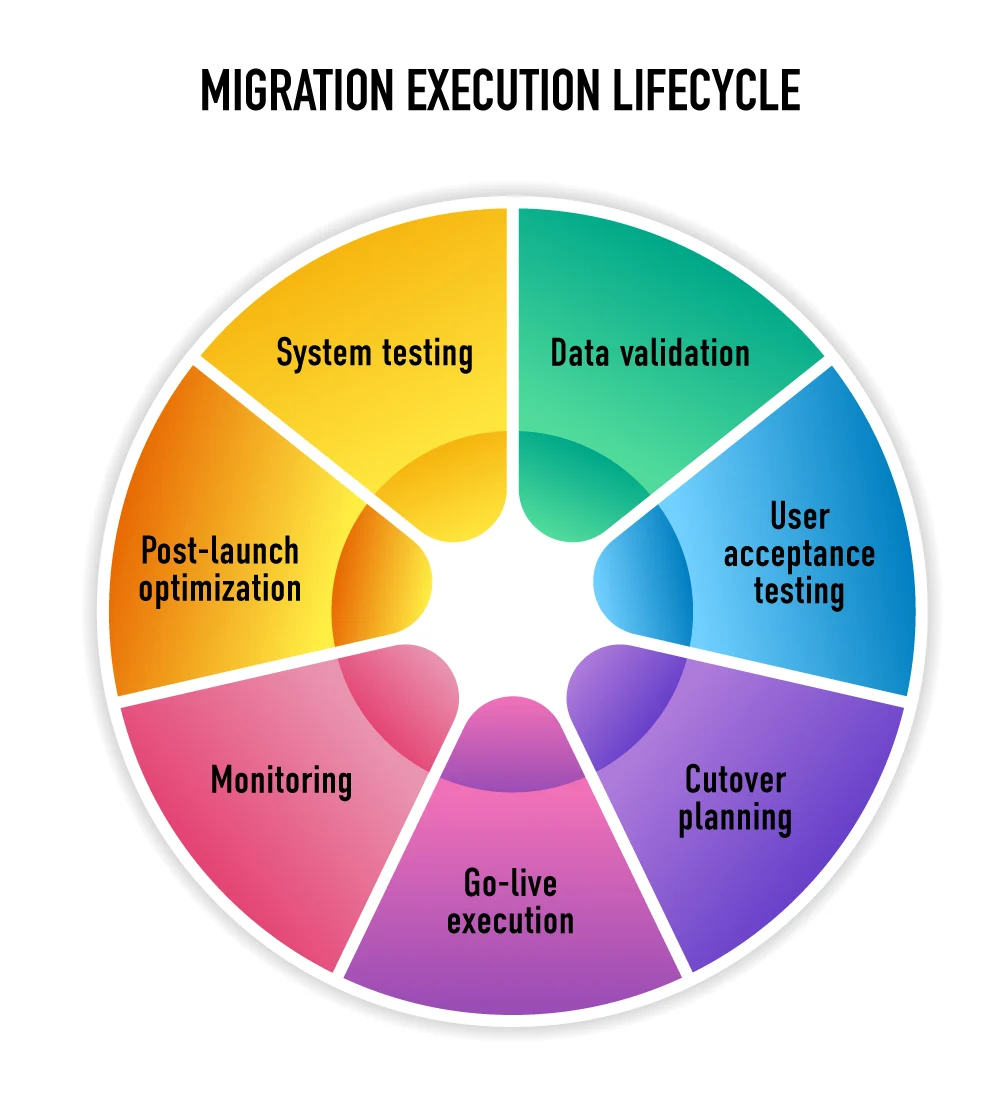
Different forms of testing are required. Functional testing verifies that the functionality is operational. Integration testing verifies that the data flows are proper. Performance testing verifies that the system has the ability to handle the number of users you expect.
Data accuracy must be checked to confirm product quantities are correct and customer data is correct. Order amounts must also be correct from source to destination systems.
User acceptance testing is critical because business users verify real-world scenarios and their approval is necessary before going live.
Cutover activities must occur in a specific order. First, data changes need to be halted and the final set of data needs to be transferred. Finally, the website URL needs to be changed, and initial tests should be conducted.
Rollback procedures need to be in place. Teams need to be prepared to reverse course if severe problems arise. There should be monitoring from minute one.
What execution planning must cover:
Functional and integration testing
Data validation checks
User acceptance testing
Cutover sequence
Rollback and monitoring
Why migration isn’t the finish line
Migration delivers stability. Optimisation converts stability into concrete business improvement. Without optimisation, teams only replace a platform. They do not increase performance.
After launch, performance is improved through regular review. Page speed is checked and slow spots are fixed. How the system works is reviewed to ensure stability.
Conversion optimisation improves revenue through reducing friction. Checkout friction is analysed and A/B testing is introduced. Small improvements compound over time.
Search and product displays need improvement to support discovery. Search results are made more accurate and category pages are changed. It becomes easier for customers to find products.
The roadmap must be maintained and enhancements are planned in cycles.
What optimisation should focus on:
Performance tuning
Conversion improvement
Search and merchandising refinement
Ongoing roadmap
Iterative releases
Planning makes or breaks migration
Successful migrations use a clear plan. They focus on planning more than tools. They keep the business running and help it grow in the future.
Migration is not a single technical event. It is a controlled business change that involves multiple teams and systems working together. Success depends on understanding where complexity will live after migration — not just how to move it.
Careful research defines the project’s scope and clear goals guide the design. Simplifying things makes the process less complicated while testing makes sure everything works well.
When these steps are followed, companies become more stable.
What drives successful migration:
Structured methodology
Strong planning
Controlled execution
Business continuity
Scalable foundation
The final word
Rethinking SAP Hybris is not simply about replacing one platform with another — it is about modernising how enterprise commerce is architected and operated.
Moving to SaaS changes the operating model. Infrastructure, scaling, and upgrades are handled by the platform, freeing internal teams to focus on integration strategy, customer experience, and innovation.
BigCommerce combines enterprise-grade performance with an API-first foundation designed for flexibility. Instead of managing infrastructure, teams manage outcomes. Instead of extending the core, they compose services around it.
If you’re evaluating whether SAP Hybris still aligns with your long-term strategy, request a demo to see how BigCommerce supports enterprise performance with a modern SaaS approach.

There's a lot to love ❤️
Watch a demo to see the BigCommerce platform in action.