





Written by
John Shieldsmith
Ecommerce for Distributors: How to Build a Scalable B2B Strategy
Get The Print Version
Tired of scrolling? Download a PDF version for easier offline reading and sharing with coworkers.
A link to download the PDF will arrive in your inbox shortly.
Key highlights:
Modern solutions enable B2B distributors to sell online like those in traditional B2C ecommerce.
Successful B2B distributors in ecommerce are able to scale beyond previous limits, drive efficiencies across workflows, and empower customers with self-service.
Distributors should offer advanced search, customer-specific pricing, and self-service, built upon a flexible foundation and automation that won't limit the business.
Building a distributor ecommerce site requires extensive research, goal planning, and having the right marketing and technical support teams in place.
Distributors shifting to an ecommerce model can help existing clients onboard by guiding them through the process and offering incentives for early adopters.
Ecommerce now spans nearly every industry, helping businesses from retailers to wineries reach larger audiences. Distributors are increasingly adopting ecommerce as well, bringing digital purchasing to the business-to-business (B2B) market. Platforms like BigCommerce make ecommerce for distributors possible, enabling them to deliver modern buying experiences while supporting complex pricing, large product catalogues, and repeat purchasing workflows.
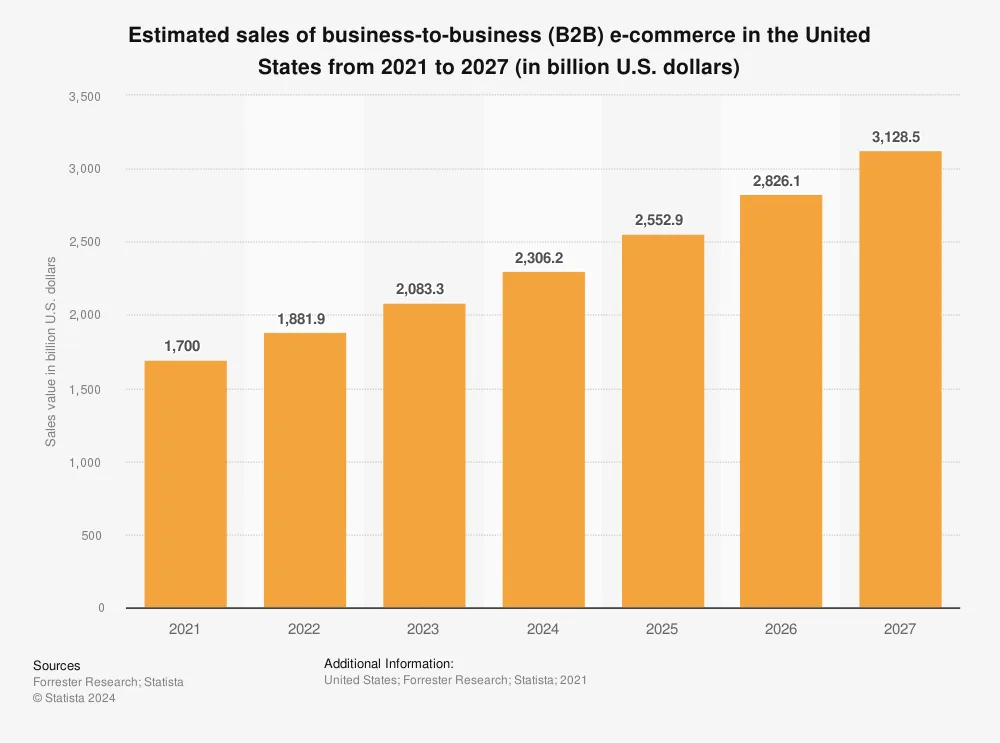
Already, the B2B ecommerce market is valued at $2.8 trillion, and set to continue growing. The same convenience that’s made ecommerce popular for business-to-customer (B2C) markets is clearly driving customers to B2B ecommerce — and distributors would be wise to meet these customer expectations.
But, distributor ecommerce is different from your run-of-the-mill B2C ecommerce, requiring the right strategic approach that factors in your own business needs and those of your customers.
Let’s take a look at the advantages of ecommerce for distributors, then, what it takes to make this model a reality.

Get a clear view of your B2B digital maturity.
Learn key areas for improvement and actionable insights to help your business grow faster and smarter.
Benefits of a modern distributor ecommerce approach
The ecommerce model brings a number of benefits for distributors that extend beyond delivering a more convenient customer experience. (This is a big perk, though.)
Whether you’ve outgrown your current ecommerce platform or you’re just entering the space, it’s never been a better time to revisit your distributor ecommerce strategy.
Adopting a new ecommerce strategy for your business (or adapting your current digital strategy) can have a huge impact on your bottom line. Here are a few ways your B2B distributing company can benefit from revisiting its digital strategy.
Room to scale.
Modern B2B ecommerce platforms are far more capable than they were even several years ago. Today’s B2B ecommerce platforms can help you streamline operations, free up resources, and ultimately open the door to true scalability with features like:
Cloud-based infrastructure that grows with your business.
Headless commerce, making it possible to quickly change your frontend without altering backend code.
Multi-storefront support, enabling you to add more physical and/or digital stores on the same inventory system.
Support for countless integrations that add functionality as needed.
Mobile app support, empowering you and your customers to engage on the go.
All of the above and more can free up precious time, giving you the freedom to focus on the customer experience and driving your business forward.
Endless innovation.
Legacy technology can often be a hindrance, no matter how attached to it you are. Modern cloud-based distributor ecommerce platforms are always updating and growing in capabilities, whether native to the platform or through plugins and integrations.
This endless innovation can extend to your business, giving you the data and tools to test messaging, customise your site and customer experience on the fly, and stay agile in a market of ever-shifting customer expectations.
Improved efficiency.
Simply put: Modern ecommerce approaches are more efficient than anything else.
Modern B2B ecommerce platforms are all about speed and efficiency, from builders that simplify site setup, to headless coding that turns just about anyone into a coder, to AI-powered automation that streamlines workflows and automates messaging.
Take Toolden, for example, who used BigCommerce to streamline both their B2C and B2B operations. In a span of four years they managed to:
Double their product offering from 30,000 to 60,000.
Streamline the buying process for customers and the selling process for employees.
Realise a 200% increase in revenue while redoing their site and UX three times.
By adopting more modern ecommerce technology, businesses have the opportunity to not only increase efficiency from a customer perspective by improving the buyer experience, but also by improving internal operations.
6 must-have capabilities for distributor ecommerce
A modern distributor ecommerce platform can make a significant impact across nearly every facet of your business, benefitting you and the customer alike. But, only if you choose a platform with the right capabilities.
Platforms like BigCommerce provide specialised B2B functionality designed for complex catalogues, custom pricing, and large purchasing workflows. When evaluating ecommerce technology, distributors should ensure the platform includes the following capabilities.
Advanced search and chatbots.
The days of a simple search bar are over. Advanced search — combined with AI-powered chatbots — helps customers quickly find the products they need.
Distributor and industrial ecommerce businesses often have thousands of product SKUs in their system. This is a lot for customers to sift through.
With both AI-powered search functionality and advanced chatbots, your customers can quickly find exactly what they’re looking. Modern AI tools can pull from the customer’s behaviour and previous purchases, surfacing the most relevant results.
Furthermore, an AI-powered chatbot can answer any questions a customer has and direct them to relevant products, content, or a specialist if needed.
Many ecommerce platforms have real-time inventory support, which paired with modern search, can ensure customers see up-to-date product availability. The user experience benefits, customers benefit, and your supply chain is healthy and happy.
Customer-specific pricing and self-service.
BigCommerce research found that inaccurate pricing was the number one pain point buyers felt during the B2B ecommerce purchasing process. This is understandable, as B2B buyers often deal with more complicated purchasing processes, and higher prices.
With customer-specific pricing and self-service options, customers can see pricing that’s tailored to them and make a decision on their own. (Remember Toolden and their streamlined buying process?)
Advanced automation.
Distributors already manage large order volumes. When you open this up to a greater audience with the ecommerce model, you’re opening your company up to higher volume orders, a larger customer database, and more, more, more.
A modern distributor ecommerce platform needs advanced automation capabilities if you want to keep up. This functionality should include:
Workflow automation that’s capable of streamlining day-to-day tasks.
Email automation that sends welcome emails, sales notifications, and more when triggered.
Product information automation that updates availability, pricing, and any altered descriptions across any number of storefronts or sites.
Marketing automation that can assist with customer segmentation, loyalty and cart abandonment emails, and more.
As a B2B distributor, you’ve got enough on your plate, and your plate will only get fuller as you scale. The right automation can make a big impact here, enabling growth without a growing burden.
AI-powered personalisation.
Along with automation, your ecommerce platform of choice should feature AI-powered personalisation, either natively or through integrations and plugins. Don’t just take our word for it: 73% of companies say personalisation is changing because of AI.
Modern AI-powered personalisation is capable of far more than adding someone’s name to a form. In fact, it can:
Pull from customer behaviour to influence product recommendations for a single shopper.
Use customer data to alter a homepage, changing which products appear.
Enable the “next best” approach, surfacing the right resource or product line at the right time, boosting satisfaction up to 20% and bolstering customer retention.
Power dynamic content, showing a visitor relevant articles or studies based on their interests.
Display more accurate popups that offer promotions or products based on customer behaviour.
In an environment where customer-centricity is the name of the game, taking advantage of these kinds of cross-sell opportunities can have a huge impact on the final sale amount. They can also help boost conversions by giving customers a final push to make a purchase they’ve been considering.
Account-level controls.
Another important requirement for your B2B ecommerce platform is access to account-level controls.
When selling into a business, you’ll likely need to juggle multiple stakeholders, different departments, and even different locations. This means having multiple people from the same organisation logging in to see order history or track down other information.
Different purchasing needs can also necessitate different purchasing scenarios. Some of your clients may insist on purchasing via 30-day invoices with a sizable credit limit, while others may have to place orders via credit card payments.
A suitable B2B ecommerce solution will enable you to accommodate different payment terms and support account-level controls for the best user experience.
A solid foundation for innovation.
Historically, the distributor business model required specialised solutions. These pieces of legacy tech, while useful at one point, are often limiting in this modern, agile environment.
A modern, cloud-based distributor ecommerce platform can act as a foundation for innovation by offering:
Seamless integrations with trusted partners, allowing expanded functionality only when needed.
Controlled access, with experiences and pricing structures tailored to meet the needs of individual customers.
Support for multiple storefronts with synced inventory.
Configurable order processing with custom workflows, easy reordering, and beyond.
Customer resource management (CRM) and enterprise resource planning (ERP) integrations with secure cloud storage, making data management easier and safer as your customer and product bases grow.
Our research shows that B2B customers value detailed product information, custom pricing and discounts, account management, and efficient reordering above all else. With a modern ecommerce platform, you’re building the foundation for exactly that.
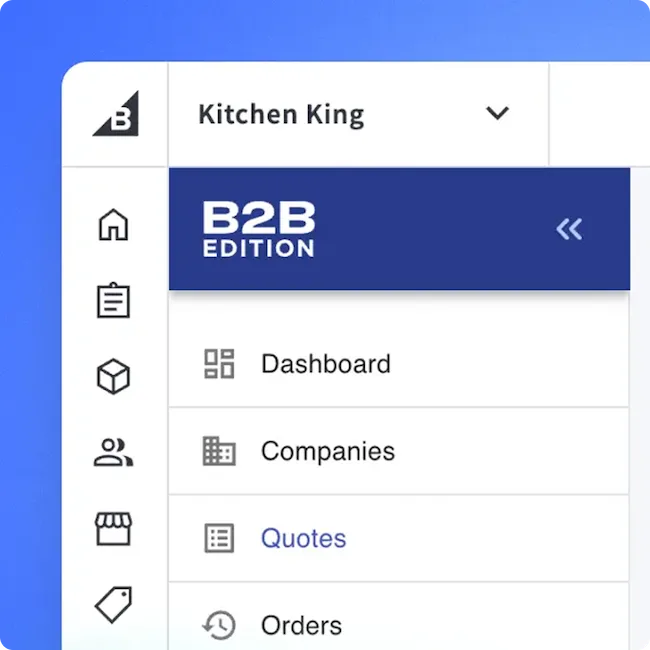
We're serious about B2B.
BigCommerce B2B Edition gives you account management and quoting tools to help your sales team get more orders.
Steps for distributors to build an ecommerce site
Modern B2B ecommerce platforms, like BigCommerce, have made it easier than ever before to quickly build a professional, functional ecommerce site. A little planning still goes a long way.
Follow these steps to set yourself down the path of success and avoid getting caught in any potential pitfalls.
1. Set project requirements.
Yes, it’s incredibly easy to make a flashy website. It’s also easy to fall prey to feature creep, spending far too much time and energy on a site that never ends. You’re not building the Winchester house, you’re making a goal-oriented site.
Setting clear project requirements will help you by putting guardrails in place, realistic goals, and ensuring your efforts have focus. When setting these project requirements, be sure to involve stakeholders from across your teams, as launching an ecommerce site takes a village.
“Launching an ecommerce site isn't just a tech decision. It's an architectural decision. There are backend considerations, inventory, credit terms, integration, and so on. And there's the team element required to make it all happen. Operations, finance, sales, marketing, all coming together to answer the question: how do we translate what we have, into a digital experience?”
-Samuel Palomares, Account Director, BigCommerce
There are a number of steps you can take to help you determine what those goals should be as you embark on this journey.
Learn from competitors.
Take a look at the online stores of your competitors and ask the following:
What do they sell?
How do they sell it?
How do they advertise online?
What common website features do they have in common?
What are they missing?
Be sure to search for your products on omnichannel marketplaces like Amazon Business. Consider how your product compares to others online, and whether your value proposition is enough to stand out from the crowd.
Structure your catalogue.
Whether your catalogue is a few dozen products or in the thousands, a structured approach to your catalogue will ultimately make for a smoother shopping experience and boost customer satisfaction.
When structuring your catalog, make sure to:
Feature quality images that showcase the product in its best light.
Include clear, complete product descriptions that don’t mislead the customer.
Organise by category and subcategory, making it intuitive for customers to find what they need.
Practise generative engine optimisation (GEO) on product pages so they’re more likely to show up in popular AI-powered engines.
At the end of the day, think about your customer needs and whether your b2b product catalogue is laid out in a manner that makes sense.
Account for taxes.
Taxes aren’t the most exciting thing for most business owners, but they’re also important. Plan ahead for taxes, picking out a service like Avalara or TaxJar to calculate taxes in real-time at checkout.
Plan for fulfilment.
An increase in sales from switching to a modern distributor ecommerce model is great, but with that you’ll also get an increase in fulfilment demands. This is another area where modern integrations can make a difference.
Choose an ecommerce platform with ERP integrations. This can enable automatic inventory updates, with your system reflecting any sales immediately across your storefronts and systems.
You can further speed up fulfilment with professional fulfilment services, who can handle inventory, shipping, or both in many cases.
Consider your payment options.
Whichever platform you choose should support multiple payment gateways and methods — the second-most popular reason for cart abandonment is a lack of payment support, after all.
For example, BigCommerce, integrates natively with more than 55 global payment gateway options. Plus, our B2B buyer invoice portal makes B2B purchases simple and easy, giving buyers all the B2B tools and options they need to make a successful purchase.
Create clear goals.
With all of the above in mind, it’s time to create clear goals. Are you wanting to drive sales? Expand your customer base? Reduce costs?
Whatever your goals, make sure they’re measurable, have clear outcomes, are time-bound, and realistic.
Some common distributor-specific metrics to follow include:
Site adoption rate: What percent of your orders are taking place online?
Self-service ratio: Are people using self-service options, or requiring help from sales?
Average order value: While average order value by segment is helpful, because your site is new, measure the average order value in comparison to your pre-ecommerce revolution.
Cart abandonment rate: Track your cart abandonment rate right out of the gate, making tweaks and A/B testing over time to see what helps.
There are countless metrics to track. Avoid analysis paralysis and choose a few to focus on and tie goals to at first, then expand from there.
2. Identify potential obstacles.
Growing pains are inevitable, but this doesn’t mean obstacles have to crush your ecommerce dreams. Every industry and business will have unique obstacles, but planning for the following can help you stay ahead of the curve.
Account creation.
Self-service options and customer portals are a huge reason to embrace the ecommerce model, but they also come with the potential for technical hiccoughs.
Prepare your team for an influx of accounts being created. Expect some users to have challenges when creating their help, requiring basic support. You’ll also want an internal review process in place to ensure customer profiles are displaying the right prices and products.
Shipping costs.
Thirty-nine percent of customers in the U.S. abandon carts over various unexpected costs, including shipping. Shipping can be especially expensive in the B2B space, especially if you’re selling heavier items that require specialised shipping.
Work to find the most cost-effective shipping possible, whether it’s region-specific or a broader partnership. From there, give customers the ability to estimate shipping costs before they get to the final checkout process.
Regulations and compliance.
On top of the logistics behind shipping your products, you also want to prepare for any regulations around shipping across state lines.
Depending on the type of products you sell, you may or may not run into state-specific laws that complicate sales and shipping. Check with your local government website or resources to determine if you have any regulations that might impede operations.
On top of this, make sure you’re prepared for the various ecommerce-specific compliance requirements ahead of you.
3. Build your ecommerce team.
Before launch it’s important you have the right support team in place. Whether you want to build an in-house team or outsource to agency partners, there are several areas you’ll want support.
An experienced marketing team.
Chances are you have been doing some sort of marketing for your B2B business, but marketing your products (and reaching the right audience) from an ecommerce perspective is vastly different than traditional means.
An experienced marketing team can help you:
Stay on top of search engine optimisation (SEO), increasing the chances your site and products show up on search engines.
Draught ad copy, product descriptions, articles, and more, taking SEO, answer engine optimisation (AEO), and GEO into consideration.
Design professional imagery for your site, ads, copy, and across your branding.
Spend your ad budget effectively, targeting where it makes sense and optimising when needed.
Ecommerce marketing is incredibly nuanced. Whether you do it yourself or outsource, creating a plan ahead of time is crucial to long-term success.
Technical experts.
New ecommerce sites, various integrations, account creations, and countless other elements can all result in a technical nightmare. You’ll want the right technical experts ready to ensure the smoothest launch possible.
Like a marketing team, you can go in-house or outsource to an agency. In either event, you want a team that can help you before, during, and after launch with any number of technical hurdles, including API integrations, front and backend coding, and more.
This is also where the right ecommerce platform can help, as they too should provide great technical support in the event of an issue using their services.
Leadership buy-in.
Getting your leadership team to buy-in to a digital transformation can be challenging. Despite B2B ecommerce’s rapid growth trajectory, many B2B business owners or executives find it hard to find value in the shift to digital.
It’s important to have buy-in from all levels of leadership to ensure a smooth digital transformation. Help leaders see the benefits of this ecommerce shift by:
Showcasing the clearcut goals in place for your launch.
Pointing to competitors using a modern ecommerce approach.
Highlighting potential gains and time saved with modern ecommerce automation.
Citing customer case studies that point to the benefits of B2B ecommerce.
“Don’t speak technology, speak EBITDA. Show that you’ve done your research and illustrate how a self-service option saves you X dollars per-sale, multiplied across the hundreds or thousands of orders you manage each year. THAT, is an interesting conversation they’ll want to hear.”
- Samuel Palomares, Account Director, BigCommerce
It may not happen overnight, but with an honest, dedicated approach you can help leadership see the potential behind a well-orchestrated ecommerce pivot.
4. Select your ecommerce technology.
Picking the right ecommerce platform is a critical step in the journey. Make sure you leave yourself enough time to investigate the available providers and consider what’s important to your business.
Here are some things to consider when looking for new ecommerce technology.
How much will the platform cost now, and what about as you scale?
Are there any pre-built functionalities, integrations, or automations that might save you money?
How easy or difficult will it be for you to maintain your ecommerce website?
Will you need to manage security, patches, and other updates yourself?
Does the platform offer the functionality you need, natively or via integrations? Do the integrations cost anything extra?
Will the platform allow your business to keep up with industry trends and changes?
Is the platform scalable, and does it stay within your budget as it scales?
There are many aspects to consider when it comes to a B2B ecommerce platform. Take the time to educate yourself on the best fit for your business, going back to your goals when in doubt.
Ebook: B2B Digital Maturity Guide
Discover your maturity level as a B2B storefront and learn how you can improve.
Marshall Wolf Automation: Saving time with BigCommerce
Marshall Wolf Automation, a women-owned industrial automation distributor, has been in the B2B space for more than 40 years. As the B2B market and expectations began pivoting, the company soon found their legacy platform wasn't up to the task.
The team at Marshall Wolf Automation was drawn to the number of built-in B2B features at BigCommerce, including customer-specific pricing. With developer-friendly tools, BigCommerce also enabled the Marshall Wolf Automation team to maintain the level of control they wanted, with easy development and testing in an app sandbox.
In the end, Marshall Wolf Automation was able to streamline operations inside and out, delivering a better customer experience while also improving workflows for employees. This resulted in:
25-30% reduction in platform maintenance time.
100+ hours saved annually on manual tasks.
Improved agility as a business.
“We're really hoping to continue building on how our sales team uses the platform to help customers. It gives them the ability to place orders online, get quotes, access their pricing, and receive faster responses — instead of waiting on back-and-forth emails.”
-Tyler Jensen, Director of Technology, Marshall Wolf Automation
Preparing your site to serve your ecommerce customers
Launching into the ecommerce space means adhering to the industry standards and expectations. As part of this, you need to make sure your team is ready to help your B2B buyers, and that those customers are prepared for the shift, too.
Train your internal team on using your website.
Don’t launch your ecommerce site to customers until your B2B sales reps know it in and out. Training the team in advance will give you enough time to test various purchasing scenarios, catch any remaining bugs, and prepare the sales team for a different kind of sales process.
Before launch, your sales team should be able to answer customers’ questions and guide them through the self-service online sales process, if needed.
Plan an introduction of the site to existing customers.
Sure, you want your new ecommerce site to attract equally new customers, but you also don’t want to alienate or alarm existing customers either.
Create a series of communications, from emails to social media posts, that hint at upcoming changes. Within the emails, be a little more detailed and let your customers know a big change is coming.
Make it clear that this change won’t impact the quality of your services or products, but give them further access to deals and products when they need them. Drive home the benefits just as you would with stakeholders.
Lastly, send an email out alongside launch, guiding your existing customers through the onboarding process, with clear ways to access support if they need it.
Prep customer support for an influx of communications.
Timely customer service is one of the most important aspects of an ecommerce business. If you’re just getting started, customers are bound to have questions and concerns.
Promptly following up on customer support enquiries will boost your brand’s trustworthiness and encourage customers to shift to online processes, so make sure your team is ready to help as quickly as possible.
Set up live chat on your ecommerce site.
On-demand chatbots have changed the game in ecommerce. Instead of having to arrange a call and wait for an answer, consumers can now ask quick questions and get immediate answers right where they need them.
Embrace the AI-powered chatbot revolution, putting these helpers in place before launch. This will ensure customer questions are answered promptly, with advanced support getting routed to human specialists when they’re needed.
Practise post-launch optimisation.
The work isn’t done once your site is live. (I know, it’s a bummer.)
With your site up and running in all its glory, it’s time to focus on post-launch optimisation. A few primary areas to focus include:
Catalogue refinement: Ensure catalogue listings are optimised for SEO and the like, test different category names if they’re not performing well, and be sure to tag new products as they’re added.
Personalisation improvements: Always look for new personalisation opportunities, from further refining chatbot interactions to product recommendations improvements to ensuring new content is surfaced when appropriate.
Checkout streamlining: Keep tabs on cart abandonment to see if your checkout process is too complicated, asks for too much information, works well on mobile, and so on.
As you A/B test various elements of your site and experience, continue to track data. Look for trends, take note of customer interactions in chatbots, pay attention to competitors, and don’t ever stop improving your site.
The final word
Customer expectations in B2B commerce have already shifted toward digital purchasing and self-service ordering. Distributors that invest in ecommerce can meet these expectations, improving operational efficiency, expanding their customer base, and delivering better buying experiences.
With the right strategy and technology, distributors can build scalable ecommerce operations that support long-term growth.
BigCommerce offers a platform that can help you set up a professional site with access to extensive functionality and a host of integrations and plugins.
Whether you’re just embarking on your distributor ecommerce journey or looking to shift platforms, BigCommerce can scale to meet you and your customers wherever they are.
Schedule a demo and see how we’ve helped countless B2B companies like Marshall Wolf Automation save time and find success in today’s agile market.
The best ecommerce platform for distributors depends on factors such as catalogue size, pricing complexity, required integrations, and long-term scalability.
Distributors need to look for one thing above all else when finding a solid ecommerce foundation: an ecommerce platform that can help foster growth rather than impede it.
The right ecommerce platform comes with self-service options, enabling customers to navigate the sales process largely on their own. This can allow sales reps to pivot, focusing on larger-scale clients and taking a more strategic role.
Distributors can balance self-service and relationship-based selling in ecommerce by giving existing customers the tools to place repeat orders and manage their own portal, while involving sales reps with new clients and those placing larger orders.
Ecommerce for distributors is all about enabling easy access to repeat, bulk purchases of products, whereas B2C ecommerce emphasises drawing in customers for individual, smaller purchases. Distributor ecommerce also utilises traditional sales and discounts less, instead giving customer-specific pricing where appropriate.
Distributors can manage their large ecommerce product catalogues by utilising enterprise resource planning (ERP) and product information management (PIM) systems, both of which automate tracking of inventory and sales across multiple locations.
By utilising enterprise resource planning (ERP) and advanced inventory systems within an ecommerce platform, distributors can improve order accuracy by reducing the likelihood of human error.
Distributors can onboard existing customers to a new ecommerce channel by communicating the benefits of the platform, supporting them during the transition, and often offering discounts for early adopters.
Proper integration of an ERP, CRM, PIM, and OMS are all critical to success in distributor ecommerce, as they each play a role in managing large inventories, bulky and complex orders, and expansive product catalogues. With a proper ecommerce platform, these integrations all come together, syncing their information in real-time and providing total insight into fulfilment.
⏰ Isn't about time that you evaluated your ecommerce platform?
Request a demo to see how the BigCommerce platform is different.