- Start & Build

Product Overview
What you can do with BigCommerce.
Agentic Commerce
 AI-powered solutions for growth.
Design Your Store
Build your store with or without code.
Apps & Integrations
Over 1,200 apps to help you grow.
Migrate to BigCommerce
Switch from Shopify, Woocommerce, Salesforce, Magento, and more.
- Launch Services
Overview
Chart your path to success with specialised services.Implementation Project Management
Experts to ensure you launch on time and under budget.Solution Architecture
Seasoned advisors to help you best design your store.Data Migration & Optimisation
Expertise on a clean and clear path to migrating your data.Enterprise Launch Package
Personal training on how to set up and launch your BigCommerce Store.

Professional Services Blog Series
Get to know our teams and how they support your success in this Q&A series.

The Global B2B Buyer Behavior Report
This in-depth report provides actionable strategies to help you sell more online.
How to Get Your Product Pages Ready for Agentic AI

Create your store and start selling today.
Create your new website.
See if the BigCommerce platform is a good fit for your business.
No credit card required.

Written by
John Shieldsmith21/04/2026
Key highlights:
Agentic AI goes beyond chatbot functionality, making it possible for customers to search for product recommendations, receive accurate suggestions, and even complete purchases.
Product pages surface in AI results when they include complete structured, unstructured, and up-to-date data.
You can optimise your product pages for agentic AI with strong metadata, a comprehensive Schema.org strategy, consistent formatting across all channels, and tools like BigCommerce and Feedonomics.
Google and OpenAI both have their own protocols for agentic AI, each unique in offerings and requirements, but it’s possible to prepare for both simultaneously.
Do you know how people are finding your products? Not long ago, that answer was simple: Google, Amazon, or your site’s search function.
Today?
58% are using generative AI tools in place of traditional search.
Generative AI and agentic AI tools are increasingly common, enabling shoppers to get quick, personalised recommendations. With this shift in search habits comes an increasing importance to have agentic commerce-ready product pages.
This wouldn’t present a problem, were it not for one simple fact: none of the ecommerce leaders BigCommerce surveyed said their product pages are entirely ready for agentic AI.
Most product pages are built for human readers, not for the structured data and signals AI agents rely on to surface products.
Humans are great, but without agent legibility — the act of ensuring a page has the right schema, markup, and data fields — AI agents won’t be able to surface your products for the 58% already embracing AI-powered search.
Major players in the AI space are already focusing on this, with more than 20 vendors partnering with Google to launch the Universal Commerce Protocol (UCP), and OpenAI launching its own Agentic Commerce Protocol (ACP).
The good news: You can start getting your product pages ready for agentic AI and agentic commerce today.
The even better news?
Early adopters have a chance to get ahead.
What is agentic AI?
At its core, agentic AI is any AI-driven system — like OpenAI, Gemini, Copilot, or Perplexity — that performs a task for a user by pulling from natural language and data.
In the case of ecommerce, agentic AI can power shopping processes, with users able to punch in a request or ask for a recommendation, which the agent fulfils. Platforms like BigCommerce enable the structured product data these systems rely on to accurately surface and recommend products.
A search engine can deliver recommendations based on the query entered by the user, their location, and their search history (depending on the search engine). The data that’s available about a particular product completes the other half of the puzzle — AI does it best to match the most relevant product to the user’s search.
AI shopping agents are capable of giving more personal recommendations because of:
Contextual data: Numerous datasets, from product page info to social media to product availability, that informs a specific product recommendation.
Historical data: If the right application programming interface (API) is in place, agentic AI can pull a shopper’s historical purchase history from a store, further informing and personalising any recommendations.
Real-time data: Lastly, agentic AI uses real-time data, pulling in everything from the words someone used, their sentiment, prior questions, items in their cart, and more.
The above is only scratching the surface.
Already, AI can power agentic payments for services or products via quick chat engagements, pull tracking info for shipments, offer price comparisons, and provide value through the entire shopping journey.
Still curious how agentic AI is shaping ecommerce as a whole?
Don’t miss this piece on how agentic AI is driving a more seamless shopping experience.
How agentic AI shopping habits differ from humans
Agentic AI looks at the internet and content differently than humans, so it should come as little surprise that AI shopping workflows differ as well. Agentic AI shopping differs from human behaviour by compressing the traditional multi-step buying journey into a single interaction.
A traditional human-driven funnel usually goes something like:
Land on a product page by way of marketing, social media post, email, etc.
Click the product and continue browsing or add it to cart
Go to checkout and complete the purchasing process
An agentic AI shopping process, on the other hand, looks more like:
Receive prompt from user
Evaluate request and search through relevant datasets
Return results to user
Complete purchase or continue onto next prompt
Furthermore, there’s the potential for agent-to-agent (A2A) commerce. In this situation, someone prompts an agent, which results in that agent prompting another agent to complete a different set of actions.
For example, a customer could use one AI agent to help them find a product they need. That agent could then negotiate prices with another agent, resulting in a completed order.
Sound far-fetched?
See for yourself how A2A commerce is already taking hold, here.
The role of product pages in agentic AI
Agentic-powered shopping assistants are clearly using a lot of data to help shoppers find their next pair of running shoes or new favourite wine. So, how do product pages fit into this mix?
In order to provide their services and help people complete purchases, agentic AI pulls a few types of product page data:
Structured: Catalogue APIs, product feeds, SKUs, pricing info, and so on.
Semi-structured: Scraped product detail page (PDP) data, schema markup, and even HTML data from product pages.
Unstructured: Customer reviews, social posts, images, call recordings, and other user-generated content.
Not only are these AI assistants changing the product discovery process, they’re changing what it means for retailers to have detailed product pages.
You’re no longer writing product pages with only your customers in mind, but also various AI platforms. Any of your product feeds, APIs, or schema markup are fair game to an agentic AI bot.
Psst. Don’t miss this in-depth look at how agentic AI finds products.
How to optimise your product pages for AI agents
First and foremost, your product pages should always put the human first. Write for people, speak honestly and clearly, and let your brand voice shine.
Okay, now that that’s out of the way, how do you go about writing for ChatGPT, Gemini, Copilot, and the rest of the gang?
At Commerce, we use a three-milestone framework to put agentic readiness into perspective:
Shopper → Merchant: Is your data visible and complete for the shopper?
Shopper → Agent: Can your products be recommended confidently by AI?
Agent → Agent: Can your infrastructure support AI-led transactions?
Simply put: agentic readiness means having product pages that are ideal for shoppers and agents.
Now, how do you get there?
#1 Enrich your product attributes and metadata.
No matter the provider, agentic AI systems always rely on complete, descriptive data that aligns with a shopper’s intent or prompt.
Fortunately, the same product fields that help agentic AI fulfil a user’s request, also make for a better user experience on your site.
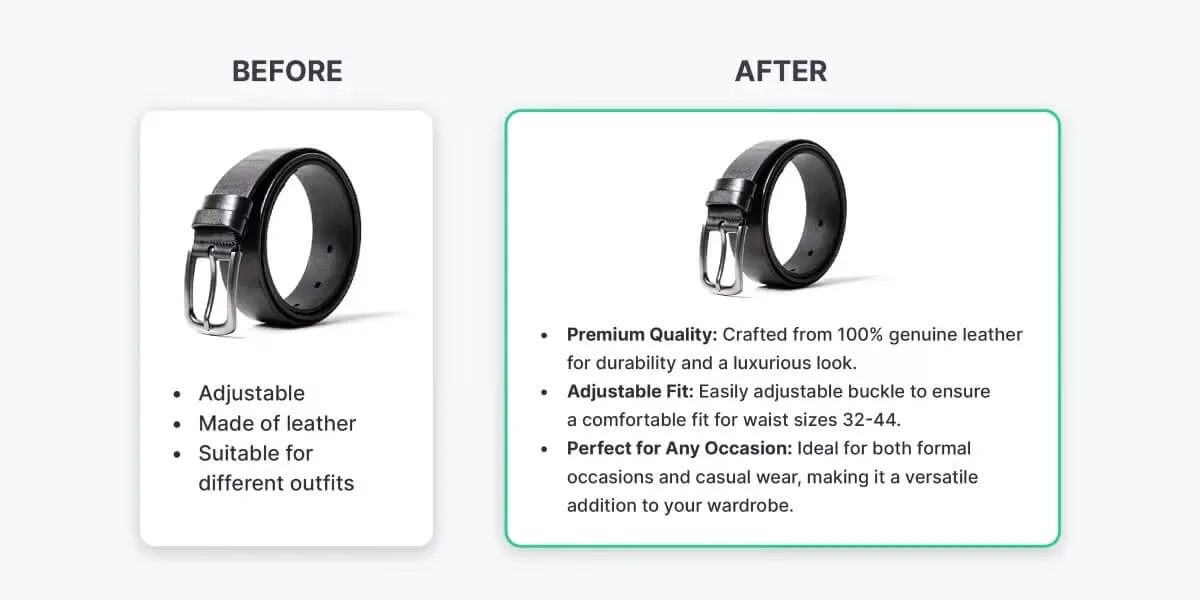
Ensure that product attributes are clearly described and set apart, not buried in paragraph copy, clearly highlighting what materials a product is made of, its size, use cases, and so on.
Note the below example and how the left copy is light and easy to miss, whereas the right uses bold font and clear, powerful words.
When in doubt, leverage tools to help you with this task.
For example, Feedonomics can automatically assist with Google Product Category assignments, while also generating agentic-ready titles, descriptions, features, and product metadata.
#2 Implement comprehensive Schema.org structured data.
Schema markup data isn’t new, as structured data has been used to assist with discovery by the likes of Google, Bing, and others for years.
But, the game has changed.
You can’t neglect classic schema best practises, but you need to give on-site structured data, like JSON-LD markup, some love, too.
Do your due diligence by providing as much detail as possible across key Schema.org markup types:
Product: Data pertaining to a product, product type, etc.
Review: Specific review data for a product or service.
AggregateRating: A product’s average rating based on total reviews.
MerchantReturnPolicy: Details on your return policy as it pertains to the item.
ShippingDeliveryTime: Concrete data with shipping and delivery estimates.
As a general rule of thumb, you should audit your top 50 product pages against Schema.org core requirements, checking that the above fields are detailed and up-to-par.
#3 Write product content for both humans and machines.
Once again, even if your goal is to be prepared for when customers use AI to find you, you still want to write content that’s fit for humans, too.
You can accomplish this by putting into place a few practises:
Write clear product titles that make sense in the context of a conversational query, and avoid keyword stuffing.
Use descriptions to answer agentic questions, including: Who is this product for? When would you use this? What problem does the product solve? What makes the product different?
Don’t hide critical product details inside PDF files, JavaScript-rendered content, images, and other types of files AI crawlers can’t access.
Once again, don’t be afraid to leverage tools for assistance here.
For instance, Feedonomics can automatically generate AI-optimised product copy, and at scale.
#4 Maintain clean, standardised formatting across your catalogue.
Consistency is key where winning over agentic AI is concerned. Make sure you use the same formatting across:
Units of measurement
Pricing
Attribute styles and casing
Titles
Material descriptions
Not only is the above consistency important for agentic AI, it also makes it easier to incorporate automation via product information management (PIM) tools and inventory management systems.
#5 Keep your data synchronised and updated.
Up-to-date data can only ever be a good thing in ecommerce, powering automation, ensuring customers get the latest info when browsing your store, and in the case of agentic AI — helping AI find the most relevant results for users.
Regularly check that your pricing, inventory, descriptions, and other datasets are up-to-date across the board.
There are various ecommerce tools that can help with near-real-time data syncs, from PIM for updating product descriptions to inventory systems for updating stock to Feedonomics, which automatically syncs product data across your platform.
Maintaining always-up-to-date data may sound like a big ask, but it’s worth the effort. Outdated data will lead to a poor customer experience, negative reviews, and further deprioritisation of your products by AI.
#6 Prioritise reviews, ratings, and third-party validation.
Don’t forget: AI agents love unstructured data, including reviews and ratings on third-party sites.
Make sure you’ve got a treasure trove of this unstructured data for agents, and:
Encourage customers to leave product reviews
Provide low-friction review forms via email that make it easier to leave feedback
Check that AggregateRating is implemented in your Schema markup
Bots aren’t the only ones reading reviews, however; 95% of shoppers look at reviews while deciding on a product.
By pushing for more reviews, you’re not only helping AI find your site, but also helping customers shop with confidence.
#7 Ensure multichannel consistency.
Agentic AI isn’t particularly great at playing a game of telephone.
You need consistent data and messaging across all fronts, otherwise AI might pass your products up when fetching recommendations for users.
Keep prices, descriptions, availability, and other datapoints consistent across all your marketplaces, from your own site to Amazon to anywhere else your products are sold to avoid AI penalties.
This is another area where tools can help.
Feedonomics specialises in using your ecommerce platform as a single source of truth, and then disseminating that information across your omnichannel presence.
Still need a little more context?
Fear not — discover how agentic AI ranks and recommends products here.
UCP, ACP, and the emerging protocol landscape
Agentic AI is still an emergent space, and with it are emergent protocols that aim to standardise how ecommerce brands engage with this type of AI.
Google and OpenAI offer their own protocols with unique requirements and perks, but both aim to accomplish a similar goal: provide ecommerce businesses with a way to easily and meaningfully embrace agentic AI.
Google’s Universal Commerce Protocol (UCP).
Google’s UCP was announced January 2026, giving ecommerce businesses a standardised approach for leveraging agentic AI.
Google partnered major brands in the ecommerce space to create UCP, with endorsements from more than 20 partners. The end result is a protocol that features:
A structured framework for agentic AI use while ensuring merchants own their data
Coverage for the full commerce journey, from discover to checkout to post-purchase
Native checkout support for Google Gemini and Google AI mode
Compatibility with the Agents Payments Protocol (AP2), Model Context Protocol (MCP), and Agent2Agent (A2A)
UCP already lowers the barriers to entry for those wanting to get into agentic AI. BigCommerce and Feedonomics are further lowering these barriers by actively working toward full integration.
Want even more info on Google’s UCP? Get an in-depth look at UCP and what this means for ecommerce, here.
OpenAI’s Agentic Commerce Protocol (ACP).
OpenAI, known for ChatGPT and largely pioneering generative AI, is also offering a standardised way for ecommerce brands to leverage agentic AI with their ACP.
OpenAI’s ACP was launched in 2025 in partnership with Stripe, and focuses primarily on Instant Checkout within ChatGPT.
The OpenAI ACP works by pulling from a merchant’s structured product data to power the agentic side of things, while Stripe functions as the payment processor.
Learn more about the OpenAI ACP, and see how BigCommerce can seamlessly integrate with this agentic effort here.
What these protocols mean for your product pages.
Two protocols, two different companies, and potentially more protocols on the way. What’s an ecommerce business to do?
This is a rare moment where you don’t have to make a choice — prepare for both protocols instead.
Each protocol focuses on different areas, with Google prioritising a holistic commerce experience and OpenAI prioritising the checkout process, but they each require clean product data.
By preparing for both you’re receiving a few benefits:
Much of the optimisation required for ACP and UCP is protocol-agnostic, meaning any of that work will likely carry forward into future protocols that emerge as well.
Both protocols require clean data, as does agentic AI as a whole. By preparing for these protocols you’re setting yourself up for a smoother transition into an agentic AI-driven future.
Many ecommerce platforms, like BigCommerce, benefit from structured data, providing further automation across workflows and further efficiency gains on your end.
In short: there’s no harm in focusing on both protocols.
In the end, you’re only giving yourself a competitive advantage in the digital commerce space, and increasing the chances of a smoother transition into any future protocols, as well.
How BigCommerce and Feedonomics make your product data AI-ready
Plugging into the agentic AI ecosystem can feel overwhelming, but it doesn’t have to be.
Both BigCommerce and Feedonomics can simplify the process, while providing benefits that extend well beyond agentic AI.
BigCommerce as the system of record.
Remember all that structured product data agentic AI needs?
Well, BigCommerce isn’t just a comprehensive ecommerce platform, but a unified, single source of truth for your product.
BigCommerce can act as the system of record for agentic AI by providing:
A comprehensive SKU and product catalogue
A current source of truth, thanks to real-time inventory and order syncing
Multi-storefront localisation, giving you more opportunities to surface in agentic results
Native SEO features, including SEO-friendly URLs, automatic sitemaps, and microdata
Unified product catalogue and SKU management; real-time inventory and order sync
GraphQL Storefront API and REST management APIs that support agentic patterns
Agentic AI requires clean, comprehensive data, and BigCommerce can help you deliver exactly that.
Not to mention, BigCommerce empowers you to change on the fly with headless commerce, expand via omnichannel efforts, and efficiently manage your business no matter how big it gets.
Feedonomics as the execution and growth engine.
BigCommerce can provide a single source of truth where product data is concerned.
What about keeping all that data clean and error free?
Feedonomics can syndicate data across more than 100 channels, not only preventing multi-channel growth from ever limiting you, but also powering agentic AI with:
Real-time error monitoring and data QA
Campaign specific feed segmentation and product filtering for organising data
FeedAI: An intelligent Google Product Category assignment tool using machine learning
GenAI tools for producing agentic-ready product titles, descriptions, and features from metadata
Agentic AI searches high and low for the best responses.
With Feedonomics, you can more easily manage your product presence across countless channels, making it easier for agentic AI — and humans — to find you.
BigCommerce and Feedonomics: Agentic ready today
Thriving in the agentic commerce space requires data that’s both comprehensive, and of high quality.
BigCommerce and Feedonomics are no strangers to AI, having teamed up with Perplexity in 2025 to focus on AI readiness for products.
This dynamic duo can help you get ready for agentic AI, too.
BigCommerce can provide the foundation, while Feedonomics can help you leverage your data to the fullest across dozens of channels.
Houzer, a U.S.-based kitchen sink and faucet manufacturer, is a strong example of how BigCommerce and Feedonomics can work together to support scalable, high-quality product data.
With decades of experience selling through marketplaces like Amazon, Home Depot, and Wayfair, Houzer lacked a direct-to-consumer (DTC) ecommerce presence and relied on an outdated, largely informational website. This made it difficult to manage product data effectively, syndicate listings across channels, and support a growing, complex catalogue.
Already operating across multiple sales channels, Houzer needed a centralised system to launch a DTC experience while maintaining consistency and accuracy across its product data.
By implementing BigCommerce as its ecommerce foundation and integrating Feedonomics, Houzer was able to launch a fully functional DTC site in under 60 days while centralising and optimising its product data across channels.
Now?
Houzer has transformed its ecommerce operations, achieving:
150% increase in transactions
47% increase in conversion rate
118% increase in revenue
And, they’ve accomplished all this while maintaining consistent, high-quality product data across its omnichannel presence.
“The platform itself enables a very quick standup of a fully functional V1 of their site. That enabled us to take this legacy brand and build an entirely new site with an entirely new business model in six weeks.”
Michael Challinger, CEO, Houzer
The final word
Agentic commerce isn’t happening in the future — it’s here right now.
Not convinced?
By 2030, agentic AI could be playing a role in an estimated $3-5 trillion in transactions around the world.
Agentic AI will only grow in capabilities, and the competitive edge it provides today will become commonplace the longer you wait. By taking steps to prepare your product pages for agentic commerce today, you’re preparing yourself for a future where this technology will be increasingly important.
Not only this, but just like the early days of SEO and companies who embraced best practises, companies who involve themselves in agentic AI today will only become more well-known in the space over time.
Don’t take on the burden of getting agentic ready all by yourself.
See how BigCommerce provides the single source of product truth AI needs, while Feedonomics gives you the tactical scalability you need to expand into the future.
FAQs about product pages and agentic AI
What is agentic AI in ecommerce?
Agentic AI in ecommerce is a specific type of AI that responds to a customer prompt, researching, comparing, and even purchasing products on their behalf once a match has been found.
On the user end, agentic AI is similar to a chatbot, requiring text inputs. Where functionality is concerned, agentic AI is far more capable than chatbots, however.
How do AI agents evaluate product pages?
AI agents operate by combing through structured data, semi-structured data, and unstructured data. In practise, this consists of information from product feeds, schema, scraped PDP content, and user-generated content like reviews.
What structured data do I need on my product pages for AI?
Agentic AI requires several kinds of structured data on product pages, largely pulled from Schema.org types, including:
Name
Description
SKU
Price
Availability
Review/AggregateRating
MerchantReturnPolicy
Offer
Product data should be in JSON-LD format, as this is the most widely accepted and increases the likelihood that agentic AI bots find your products.
What is the difference between UCP and ACP?
Google’s Universal Commerce Protocol (UCP) is an extensive protocol, covering discovery through post-purchase, while OpenAI’s Agentic Commerce Protocol (ACP) focuses on the payment and checkout processes.
While the two protocols differ, each of them requires structured product data. It’s possible and recommended to comply with both protocols, as this increases your chances of agentic discovery.
How does Feedonomics help with agentic AI readiness?
Feedonomics can help with agentic AI readiness by acting as a strategic lever for your product data, helping with data enrichment, feed syndication across channels, real-time multichannel syncing, and AI tools to streamline data refinement.
Feedonomics is at the forefront of AI readiness in the product sphere, with active partnerships with Google, OpenAI, and others.
Do I need to rebuild my ecommerce site for agentic AI?
You don’t have to rebuild your ecommerce site or replatform for agentic AI, but can instead focus on optimising your product data layer. BigCommerce can simplify this by providing an open architecture that acts as a single source of truth for product data, while Feedonomics can handle the heavy data lifting with streamlined feed management.

⏰ Isn't about time that you evaluated your ecommerce platform?
Request a demo to see how the BigCommerce platform is different.