


- Launch Services
Overview
Chart your path to success with specialised services.Implementation Project Management
Experts to ensure you launch on time and under budget.Solution Architecture
Seasoned advisors to help you best design your store.Data Migration & Optimisation
Expertise on a clean and clear path to migrating your data.Enterprise Launch Package
Personal training on how to set up and launch your BigCommerce Store.

Professional Services Blog Series
Get to know our teams and how they support your success in this Q&A series.

The Global B2B Buyer Behavior Report
This in-depth report provides actionable strategies to help you sell more online.
Setting the Record Straight: What's Actually Changing With Our Pricing on June 1
Create your store and start selling today.
Create your new website.
See if the BigCommerce platform is a good fit for your business.
No credit card required.

Written by
Travis Hess11/05/2026
See the Plan and Pricing Updates FAQs
Key highlights:
On June 1, we’re updating plan names, revising GMV thresholds, making overage pricing more gradual, and adjusting support for our lowest-tier plan.
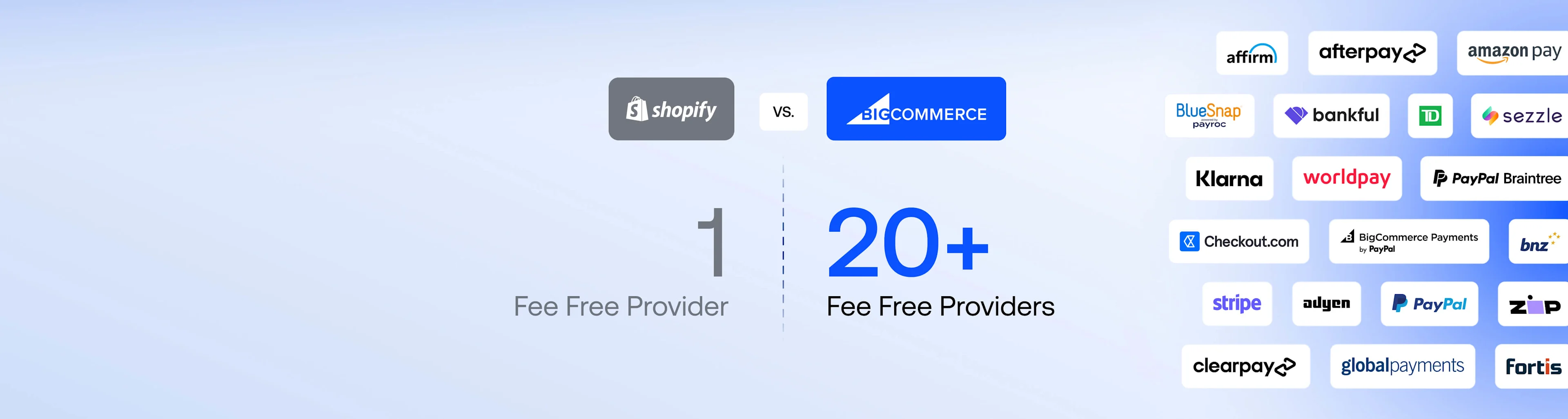
We offer 20+ Embedded Payment Provider options with no fees; self-service plans using others will incur an Open Payment Provider fee.
For many customers, this fee will not apply. Our hope is to guide merchants toward modern, fully integrated payment providers that improve checkout and conversion.
Some competitor claims misrepresent these updates—we’re setting the record straight with clear, accurate information.
If you've spent any time on LinkedIn or in your inbox over the past couple of weeks, you've probably seen some buzz about our upcoming pricing changes. The questions and concerns are valid, but the misinformation is not. The misrepresentation is coming from parties who benefit when our customers leave us for competing platforms.
Our customers and other merchants deserve the most accurate information available.
So we're doing what we've always tried to do: be transparent. Here's exactly what's changing on June 1, why we're making these changes, and what it actually means for your business.
What's actually changing on June 1st
Three things are changing, and we want to be specific about each one.
Plan names and GMV thresholds.
We're refreshing our plan names and updating GMV thresholds on some plans. Based on the updated GMV thresholds, some merchants may move to a higher-tier plan built for businesses at their scale. Others will stay the same and simply see a renaming of their tier.
At the same time, we’ve been hard at work to offer our customers more value from BigCommerce. This year, we have more feature releases and more on the roadmap than we’ve had in years, due to significant investments in research and development over the past 18 months. We are very excited to offer merchants an improved design experience with Makeswift on Stencil, revenue growth on more channels with Feedonomics Surface, a unified payments control panel with BigCommerce Payments, deeper promotions flexibility in cart and checkout, and more new features.
Support structure on our lowest-tier plan.
We're updating how support works on the entry-level plan. Details for merchants impacted by this change are available in the public FAQ we shared with customers 60 days in advance.
A new fee on Open Payment Provider transactions for Self-Serve merchants.
This is the change that's gotten the most attention — and the most misrepresentation. So let's be specific. The Open Payment Provider fee applies only to orders processed through payment providers that are not on our Embedded Payment Provider list, and only for merchants on Self-Serve plans. If your orders run through providers on our Embedded list, those orders are not subject to the fee. As of today, BigCommerce offers more than 20 fee-free, Embedded Payment Providers. That’s markedly different from our competitors.
That means our merchants have options, and we’re focusing our efforts on these integrations because we believe they offer merchants a modern, high-performance checkout.
Here’s the full list of BigCommerce Embedded Payment Providers with no fees:
Any payment provider not on this list is considered an Open Payment Provider and is subject to the fee.
Adyen
Affirm
Afterpay
Amazon Pay
Bank of New Zealand
BigCommerce Payments
Checkout.com
Clearpay
Fortis (Acumatica Payments)
Global Payments
Klarna
PayPal Braintree
PayPal Complete Payments
PayPal Wallet
Bluesnap (powered by Payroc)
Bankful (Pinwheel)
Sezzle
Stripe
TD Online Mart
Worldpay
Zip Money
Two misleading claims we want to address head-on
There are two specific pieces of misinformation circulating right now that we want to address directly.
Claim #1: "BigCommerce is now charging a transaction fee on all your GMV."
That's not what we're doing. The Open Payment Provider fee applies only to orders processed through Open Payment Providers, and only on Self-Serve plans. If you're processing through any of the major providers on our Embedded Payment Providers list, the fee is zero on those orders. For many of our merchants, that means the fee will not apply at all.
Claim #2: "A $2M merchant will pay $40,000 a year in fees."
There's a sales email going around with this exact math, and the math doesn't hold up. The email says that a $2M merchant will pay $40,000 a year in fees.
The 2% rate referenced applies only to our Core plan, which caps at $30K in annual GMV. A $2M merchant would never be on Core. On the plans that actually serve merchants at that scale, the rate is a fraction of that — and applies only to GMV processed through Open Payment Providers, which for many merchants is a small share or none at all.
Click on the video to hear CEO Travis Hess share the truth about our updates.
So, why are we doing this?
This is a fair question and one we want to answer directly.
Short-term, we're fixing something our customers have been telling us about for years. The old overage model jumped in big chunks instead of scaling smoothly. Now we have an overage model that is more predictable and linear.
For Core and Growth plans, we’ve updated GMV thresholds to better align each plan with the scale of the businesses it’s designed to support. In some cases, this means merchants move into a higher-tier plan based on the new thresholds — they will also get access to the features of the higher tier.
Merchants moving from Core to Growth access additional features such as:
Customer groups and segmentation
Abandoned cart recovery
Persistent cart (cross-device shopping)
Stored payment methods (faster checkout)
Merchants moving from Growth to Scale access additional features such as:
Advanced product filtering
Google customer reviews integration
More inventory locations and storefronts
For more details about the overage model and GMV thresholds, see the FAQs.
Long-term, we're making a bet on going narrower and deeper with our payment partners. Rather than maintaining wide-but-shallow integrations with every payment provider in the market, we're investing more deeply in fewer relationships. That means better integrations, better checkout experiences, more local payment methods, and ultimately better conversion for our merchants and a better experience for their customers.
We haven't abandoned composability
One of the louder critiques going around is that we've walked away from our commitment to being a composable, open platform. That's not true.
We're still composable. We're still open. That's not changing.
What we are doing is acknowledging that being maximally wide for the sake of being wide hasn't always served our merchants. When we favour integrations with payment providers who haven't meaningfully updated their checkout experiences in years, our merchants lose conversions. Going deeper with a curated set of partners is how we deliver a better product experience, without giving up the openness that defines how we build.
A note about the competitive pitch
The pitch some of our merchants are hearing right now is: "Come over to us. We don't charge transaction fees… if you use our payment provider."
That’s a single payment provider. One option.
The moment you choose any other provider including Stripe, PayPal, Adyen, or any of the others on our Embedded Payment Providers list — they charge you.
We took a different approach. Our Embedded Payment Providers list includes the major providers many merchants are already using. We have also made sure this list accurately serves our customer base by ensuring our B2B customers and merchants in regulated industries are covered. For many of our customers, that means the fee is zero.
If you do see fees, you can route more orders through Embedded providers without an Open Payment Provider fee.
What to do next
If you have questions about how these changes apply to your specific account, our public FAQs page is the most comprehensive resource. We published it 60 days ahead of the change because we don't want any of our customers to be surprised on June 1st.
We'll keep being transparent about what we're doing and why. Our ultimate focus is to help our customers succeed. That means doubling down on our support for best-of-breed solutions and continually investing in new and improved platform features.