- Start & Build

Product Overview
What you can do with BigCommerce.
Agentic Commerce
 AI-powered solutions for growth.
Design Your Store
Build your store with or without code.
Apps & Integrations
Over 1,200 apps to help you grow.
Migrate to BigCommerce
Switch from Shopify, Woocommerce, Salesforce, Magento, and more.
- Launch Services
Overview
Chart your path to success with specialised services.Implementation Project Management
Experts to ensure you launch on time and under budget.Solution Architecture
Seasoned advisors to help you best design your store.Data Migration & Optimisation
Expertise on a clean and clear path to migrating your data.Enterprise Launch Package
Personal training on how to set up and launch your BigCommerce Store.

Professional Services Blog Series
Get to know our teams and how they support your success in this Q&A series.

The Global B2B Buyer Behavior Report
This in-depth report provides actionable strategies to help you sell more online.
What 3,000 Consumers Told Us About the Future of AI Shopping

Create your store and start selling today.
Create your new website.
See if the BigCommerce platform is a good fit for your business.
No credit card required.

Written by
Carmen Marxuach02/07/2026
For years, the conversation around AI in commerce has centred on possibility.
Could AI help shoppers discover products faster? Could it simplify research? Could it make online shopping feel more personal?
Now we're starting to move beyond the "what if."
New research from Commerce and PayPal reveals that consumers are ready to explore a new kind of shopping experience: one where AI doesn't just answer questions or recommend products, but actively helps shoppers navigate the buying journey.
Across the United States, United Kingdom, and Australia, nearly two-thirds of consumers say they're interested in trying agentic shopping tools, signalling that AI-assisted commerce is quickly moving from emerging technology to mainstream consideration.
But there's an important distinction hiding beneath that enthusiasm. Consumers aren't asking AI to do all the shopping for them: they're asking AI to make them better shoppers.
That distinction may shape the next chapter of commerce.
AI shopping has moved from curiosity to consideration
Consumers are already becoming comfortable using AI in their daily lives. In the United States alone, two-thirds of online shoppers report using AI for tasks ranging from answering questions to generating recommendations, and more than one in four already use AI while shopping online.
What they're discovering is simple: AI saves time.
Today's shoppers already rely on AI to research products, compare options, and find the best possible price. Half of current AI shopping users say they spend less time searching for products than they do through traditional online shopping methods.
It's no surprise, then, that interest in agentic shopping is growing.
Unlike traditional generative AI tools that respond to prompts, agentic shopping assistants can continuously work on a shopper's behalf:
Helping discover products
Comparing alternatives
Monitoring prices
Assisting throughout the entire buying journey
Consumers clearly see the potential. Across all three countries surveyed, roughly two-thirds expressed interest in trying an agentic shopping tool.
This all stems from one word that shoppers seem to love: convenience.
Consumers consistently said they want AI to help them avoid overpaying, uncover promotions and discounts, reduce the time spent researching products, and identify the best option for their needs. These are practical problems that shoppers already face today. Agentic commerce simply offers a more intelligent way to solve them.
Consumers want AI to help them shop, not shop for them
One of the clearest findings from the research is that shoppers see AI as an advisor long before they see it as an autonomous buyer.
Across every market surveyed, consumers overwhelmingly preferred AI assistance during product discovery and research rather than at checkout. They want help finding the right products, comparing alternatives, and evaluating value, while keeping control over the final purchase decision. That balance between assistance and autonomy matters.
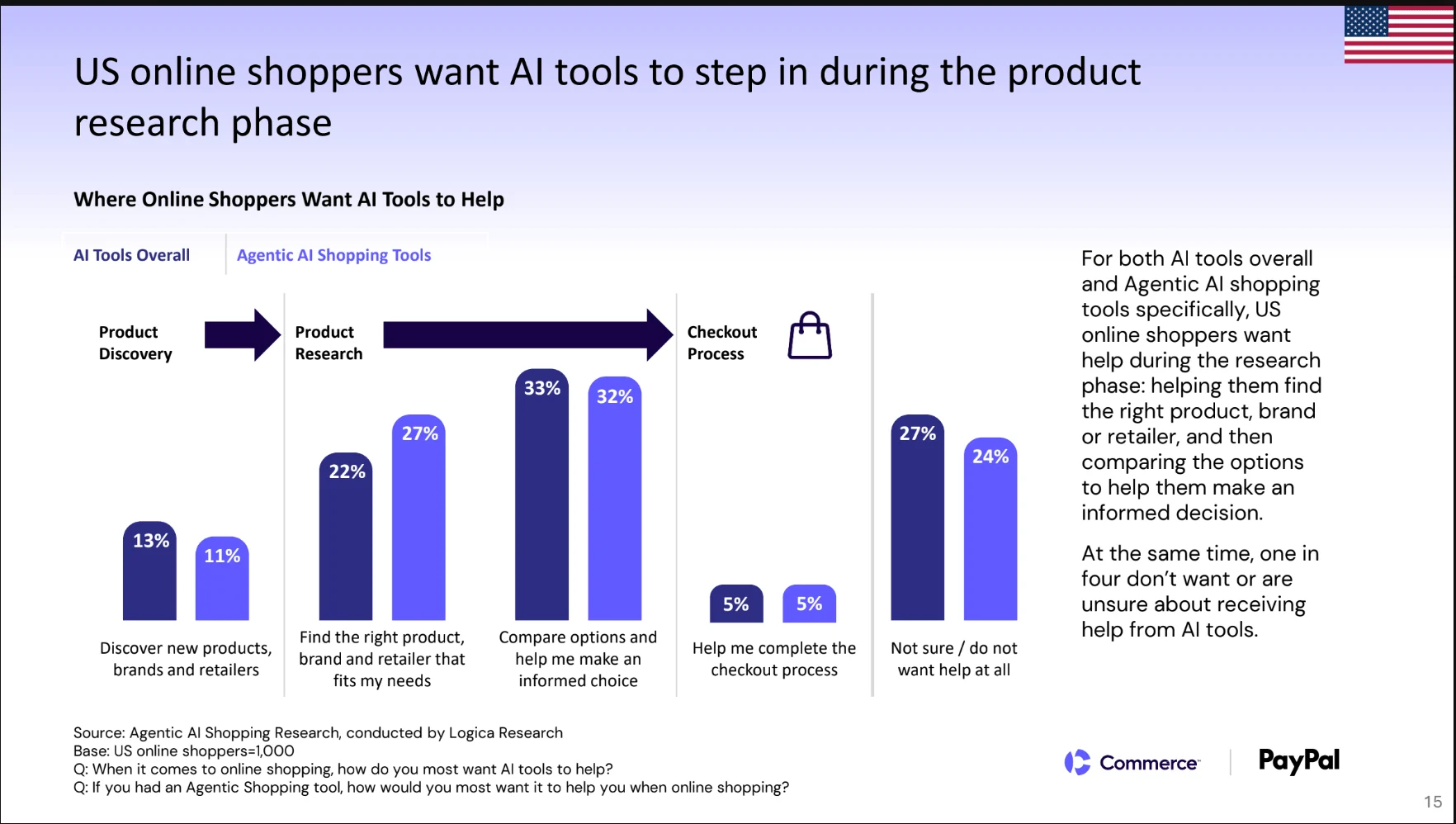
While many consumers are interested in agentic shopping, a significant share still doesn't want AI completing purchases without their approval. Instead, purchase confirmation ranks among the most important features that would increase consumers' willingness to adopt the technology, alongside fraud protection and the ability to cancel purchases without penalty.
"This research confirms the opportunity in agentic commerce is real and global. Consumers want the time and money savings that agentic commerce can deliver, but they aren't ready to trust agents as an autonomous buyer."
— Sharon Gee, Senior Vice President, AI & Feedonomics, Commerce
Merchants, take note: The next generation of commerce won't necessarily remove consumers from the shopping journey. Instead, it will help them navigate it more efficiently while keeping them firmly in control.
Trust will determine who wins the next phase of commerce
Interest may open the door to agentic commerce, but trust will determine whether consumers walk through it.
Across the research, security concerns consistently emerged as one of the biggest barriers to adoption. Consumers worry about:
Unauthorised purchases
Incorrect orders
Bank account security
Protecting personal information
Consumers also expect payment security that matches or exceeds the protections they receive through today's payment methods.
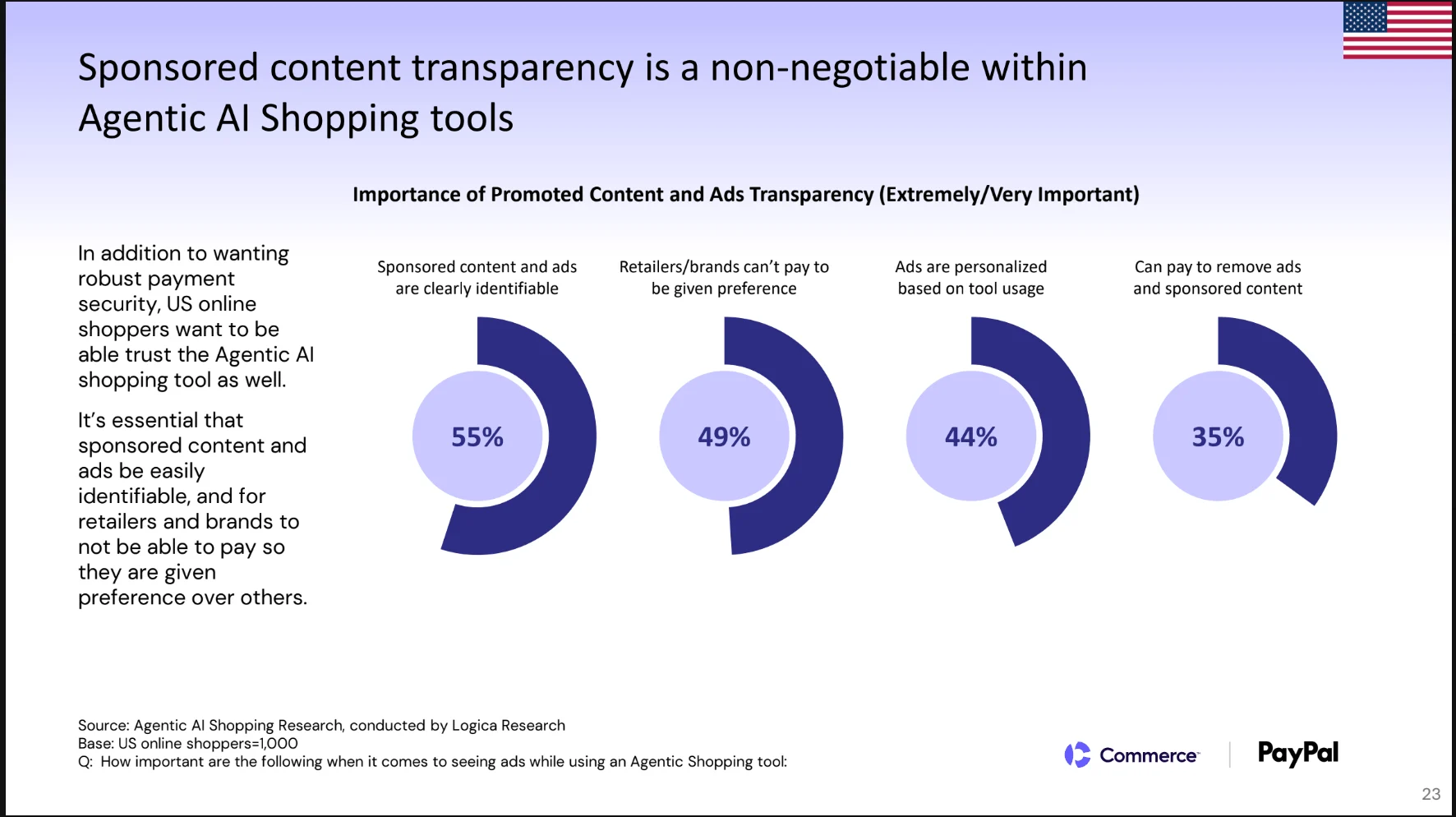
Consumers want to understand how agentic shopping tools make decisions. They expect sponsored recommendations to be clearly identified and don't want retailers to pay for preferential treatment within AI-powered shopping experiences.
In other words: They want confidence that recommendations are earned through relevance, not advertising dollars.
As Michaela Weber, Senior Vice President of Product Management for Payments at Commerce, puts it, "Trust is the foundation of every transaction, whether a purchase is initiated by a person or an AI agent."
That expectation creates both a challenge and an opportunity.
The research found that consumers haven't yet settled on a single type of company they trust most to deliver agentic shopping experiences. Technology companies, marketplaces, payment providers, and retailers all occupy similar ground, suggesting the market remains wide open for organisations that can successfully combine intelligent shopping experiences with strong consumer protections.
The future of agentic commerce is collaborative
Perhaps the biggest misconception about agentic commerce is that AI will eventually replace human decision-making altogether.
Consumers aren't asking for that. Instead, the research paints a picture of collaboration.
They want AI to do the heavy lifting of searching, comparing, monitoring prices, and surfacing relevant products. They want technology to reduce friction and eliminate repetitive work. But when it's time to spend money, they still expect visibility, confirmation, and control. That's especially true for higher-consideration purchases, where confidence matters just as much as convenience.
For merchants, that means preparing for a commerce landscape where AI increasingly becomes the first touchpoint between shoppers and brands.
Success won't come from building experiences that automate every decision. It will come from making product data discoverable, shopping experiences transparent, and payment flows secure enough that consumers feel comfortable inviting AI into more of their purchasing journey.
The brands that earn trust today will be the ones consumers are willing to shop with tomorrow.
The final word
The conversation around agentic commerce often focuses on automation. How much of the shopping process will AI eventually handle? Which parts of the buying journey will disappear?
But this research points in a different direction.
Consumers aren't looking for AI to take over shopping. They're looking for AI to remove the parts of shopping they don't enjoy: endless research, price comparisons, and information overload. What they still value is confidence, choice, and knowing they're making the right purchase.
That means the future of agentic commerce won't be defined by removing people from the process. It will be defined by helping people make better decisions, faster.
The opportunity for merchants is clear: As AI becomes an increasingly important part of how products are discovered and evaluated, trust, transparency, and consumer control won't simply be features. They'll become competitive advantages.
⏰ Isn't about time that you evaluated your ecommerce platform?
Request a demo to see how the BigCommerce platform is different.