- Start & Build

Product Overview
What you can do with BigCommerce.
Agentic Commerce
 AI-powered solutions for growth.
Design Your Store
Build your store with or without code.
Apps & Integrations
Over 1,200 apps to help you grow.
Migrate to BigCommerce
Switch from Shopify, Woocommerce, Salesforce, Magento, and more.
- Launch Services
Overview
Chart your path to success with specialised services.Implementation Project Management
Experts to ensure you launch on time and under budget.Solution Architecture
Seasoned advisors to help you best design your store.Data Migration & Optimisation
Expertise on a clean and clear path to migrating your data.Enterprise Launch Package
Personal training on how to set up and launch your BigCommerce Store.

Professional Services Blog Series
Get to know our teams and how they support your success in this Q&A series.

The Global B2B Buyer Behavior Report
This in-depth report provides actionable strategies to help you sell more online.
Keeping Commerce Weird Podcast: The Reality Behind the Agentic Commerce Hype
Create your store and start selling today.
Create your new website.
See if the BigCommerce platform is a good fit for your business.
No credit card required.

Written by
Annie Laukaitis27/05/2026
Key highlights:
AI discovery is forcing brands to rethink ecommerce beyond the storefront.
Product data quality and orchestration are becoming critical for visibility across AI systems.
Agentic commerce is evolving unevenly, with low-risk and repeat purchases likely automating first.
Loyalty and brand trust may increasingly depend on post-purchase experience and AI-driven reputation.
The future of commerce will require brands to support both human and AI-driven customer journeys.
AI is forcing ecommerce into an awkward new phase.
As discovery shifts into ChatGPT, Perplexity, and other AI-powered experiences, brands are starting to realise something uncomfortable: your storefront matters less if your data, products, and brand story can’t travel beyond it.
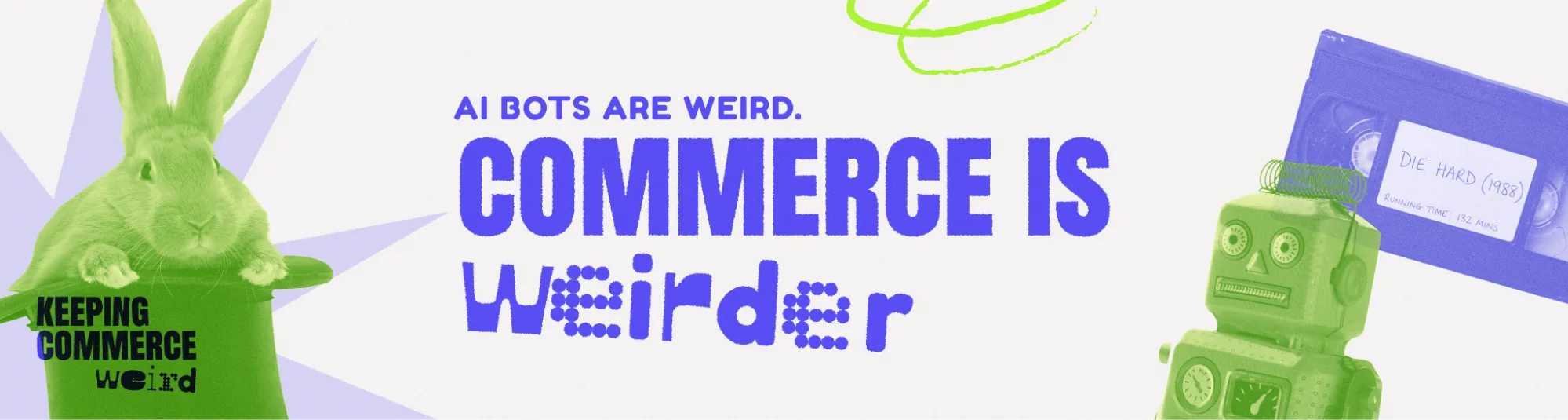
In this episode of Keeping Commerce Weird, “AI Bots Are Weird: Commerce is Weirder,” Travis Hess sits down with Heather Hershey, Research Director at IDC, to separate the reality of agentic commerce from the hype.
The conversation dives into messy product catalogues, AI discovery, autonomous shopping, and why humans still matter more than the industry wants to admit.
Here are the key insights from the discussion.
Keeping Commerce Weird podcast recap: AI Bots Are Weird: Commerce is Weirder
Product data is becoming the new storefront.
Travis Hess: Commerce has historically been a very storefront-centric business. But now discovery is becoming more distributed, more data-centric, and more orchestrated across AI systems. Are brands finally realising how important their product data actually is?
Heather Hershey: “The important theme is the data needs to be there for that discovery mechanism to work properly, or else you're just going to be shouting into the void.
If you are a marketer, merchandiser, or retailer who has been shouting into that proverbial void, you're probably really interested in AI. You want to understand how it works, how you can harness it, and how to stop getting buried by it.
Especially for retailers that were married to the old model, where the website was essentially a digital version of the catalogue and they had complete control over what was staged and how.
But once you're trying to get discovered in an agentic discovery channel, or syndicate content into social commerce and other environments, there are strict mapping considerations that have to be constantly managed. And those requirements keep changing.”
Key takeaway
For years, product data lived quietly in the background while brands focused on storefronts and frontend experiences. AI is flipping that equation. As discovery moves across answer engines, marketplaces, and agentic systems, structured product data is becoming one of the biggest factors in whether a brand gets surfaced at all.
The challenge is most organisations were never built for this level of orchestration. Clean catalogues, standardised attributes, governance, and syndication are no longer backend housekeeping. They are quickly becoming competitive advantages.
Agentic commerce is moving faster than organisations can adapt.
Hess: How aligned are people right now with what’s going on with agentic commerce?
Hershey: “I don't think they are. I think everyone knows something big is happening, but it’s much harder to actually say what is big about it, what will really change, or where everything will be in even six to 12 months.
Part of the challenge is that the word ‘autonomy’ itself is fraught because it’s a range. It’s not really a destination. It’s more about the journey of how much autonomy you’re willing to give a system.
Certain domains within digital commerce will have a higher degree of autonomy much faster than others.”
Key takeaway
Most brands understand AI is changing commerce. Far fewer understand what operationally needs to change because of it. That disconnect is creating a market full of urgency, experimentation, and uncertainty all at the same time.
The reality is agentic commerce is unlikely to arrive all at once. Adoption will happen unevenly across channels, use cases, and industries, which makes flexibility and adaptability more important than chasing a single vision of the future.
Autonomous shopping will work best for low-risk purchases.
Hess: Do you agree that when agentic commerce does work, it will probably be limited to less risky products and recurring purchases first?
Hershey: “I agree with that completely. There are some people that genuinely despise shopping. They know they want something, but they don’t necessarily want to go hunting for it.
I think agentic commerce would be best suited for people who are like, ‘They just discontinued my favourite razor blade. What’s the closest thing?’ And it gives you a bunch of options and you’re like, ‘Okay, whatever this is the best price, go buy it.’
But when it comes to the high-emotional purchases, things that are supposed to say something about you, you might want to actually be more involved. Then the agent will do most of the discovery for you to filter out the noise, because there’s a lot of noise in ecommerce.”
Key takeaway
Agentic commerce may ultimately reshape convenience shopping before it reshapes emotional shopping. Repeat purchases, replenishment, and low-risk buying decisions are natural fits for automation because consumers already view them as transactional.
But commerce is still deeply emotional in many categories. For purchases tied to identity, taste, or experience, AI may become more of a guide than a replacement, helping narrow choices while humans retain control over the final decision.
AI agents are reshaping loyalty and trust.
Hess: Help me understand why agentic commerce is good for brands that already have loyalty and affinity. How does an agent actually care about a points system or brand loyalty?
Hershey: “A lot of what’s going to be differentiating about a brand experience will happen post-purchase or right around the time where the transaction takes place.
If brands are not actively engaging in this agentic future, feeding these systems information about their products and brand narratives, they can’t assume a good-faith actor will do it for them.
Consumer complaints, forums, Reddit, all of these things that we know are pools of data for these bots, may become primary sources of information about brands and products.
The AI is going to generate its own response about what you’ve asked. It’s going to tell the story of that brand and why it matters.
That means brands have to think about how they communicate on multiple levels. It has to be data-first, but it also needs the emotional hook, the storytelling, and the informational context behind the brand.”
Key takeaway
As AI systems become intermediaries in the buying process, loyalty may shift away from polished storefront experiences and toward trust, fulfilment, reputation, and post-purchase experience. Brands can no longer assume they fully control their own narrative online.
In an agentic future, AI systems will increasingly synthesise brand perception from across the internet. That makes structured product data, reputation management, customer experience, and brand storytelling more interconnected than ever.
Commerce experiences now have to serve both humans and bots.
Hess: If this future is truly agentic, then all of this has to work end to end — not just one part of the customer journey, but the entire experience. Is that a fair characterisation?
Hershey: “I would say that’s true, but you also have to be willing to pivot. If you get the indication that a human has taken the reins back and is now engaging with you, what’s that going to look like?
It transcends the channel. It transcends whether it’s a human or a bot. It is literally a consistent, fluid experience all the way through. I don’t think many brands are actually thinking about it that holistically.
This is going to get a lot more complicated. It’s like a web, a matrix of potential channels and interactions, and they all have to be unified somehow so you can keep track of what’s going on.”
Key takeaway
The future of ecommerce is unlikely to be fully human or fully autonomous. Most experiences will move fluidly between AI agents, people, channels, and surfaces depending on context, intent, and complexity.
That creates a new challenge for brands: building systems flexible enough to support both machine-driven efficiency and human-driven decision-making at the same time. The companies that succeed will be the ones capable of orchestrating consistent experiences across increasingly fragmented environments.
The final word
AI may be dominating the commerce conversation, but as Heather Hershey explains in this episode of Keeping Commerce Weird, the real challenge is not simply adopting AI — it’s operationalising it.
As discovery becomes more distributed and customer journeys become less predictable, brands will need to rethink everything from product data and governance to loyalty and customer experience.
But even in an agentic future, commerce is still human. Trust, emotion, and brand affinity still matter, especially for purchases people actually care about.
If you want the full conversation, watch “AI Bots Are Weird: Commerce is Weirder” on YouTube or listen on Spotify.

Keeping Commerce Weird
A business podcast, but make it weird. New episodes out now.