- Start & Build

Product Overview
What you can do with BigCommerce.
Agentic Commerce
 AI-powered solutions for growth.
Design Your Store
Build your store with or without code.
Apps & Integrations
Over 1,200 apps to help you grow.
Migrate to BigCommerce
Switch from Shopify, Woocommerce, Salesforce, Magento, and more.
- Launch Services
Overview
Chart your path to success with specialised services.Implementation Project Management
Experts to ensure you launch on time and under budget.Solution Architecture
Seasoned advisors to help you best design your store.Data Migration & Optimisation
Expertise on a clean and clear path to migrating your data.Enterprise Launch Package
Personal training on how to set up and launch your BigCommerce Store.

Professional Services Blog Series
Get to know our teams and how they support your success in this Q&A series.

The Global B2B Buyer Behavior Report
This in-depth report provides actionable strategies to help you sell more online.
Keeping Commerce Weird Podcast: Commerce Has a Control Problem
Create your store and start selling today.
Create your new website.
See if the BigCommerce platform is a good fit for your business.
No credit card required.

Written by
Annie Laukaitis13/07/2026
Key highlights:
Commerce has mistaken control for certainty, creating unrealistic expectations around speed, convenience, and customer behavior.
Simpler technology hasn't made commerce less complex. It has raised the bar for strategic thinking.
AI is reshaping discoverability today, requiring brands to rethink how they structure content, data, and customer experiences.
The industry's biggest challenges are shared, making collaboration more valuable than chasing the latest buzzword.
Long-term success still comes from earning trust, embracing complexity, and focusing on the fundamentals.
Why the industry's biggest assumptions deserve a second look
Commerce has never had more technology, more data, or more confidence about where it's headed. Yet many of the industry's biggest assumptions, from instant gratification and AI to customer loyalty and profitability, deserve a second look.
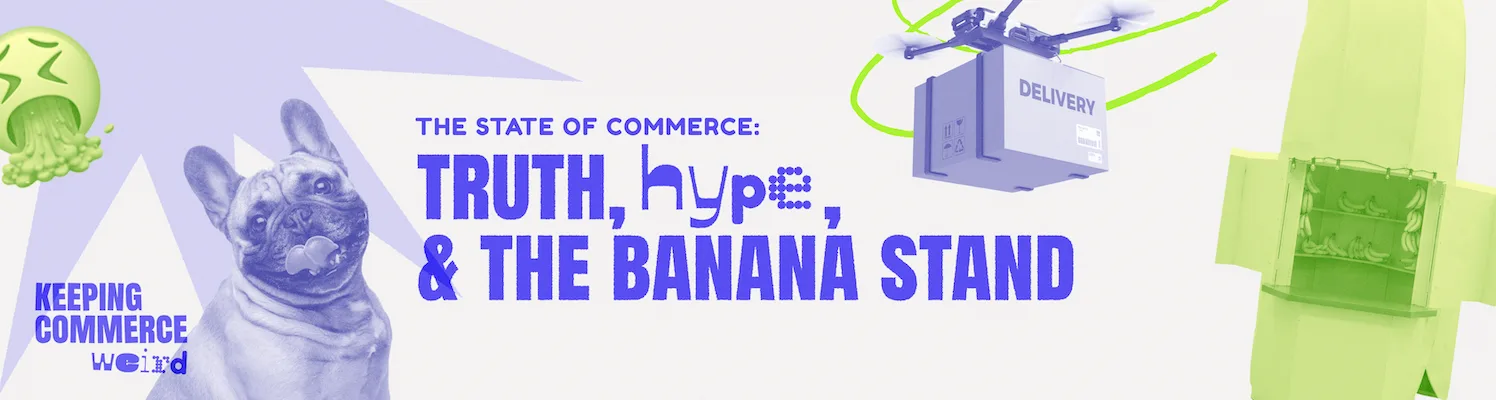
That's the focus of this episode of Keeping Commerce Weird. In "The State of Commerce: Truth, Hype, & The Banana Stand," Travis Hess sits down with ecommerce strategist, industry commentator, and Group Strategy Director at TRC Solutions, Vinny O'Brien, to unpack the trends everyone is talking about, the ones nobody is talking about, and why the commerce industry may be solving the wrong problems altogether.
Rather than chasing the latest buzzwords, the conversation challenges conventional thinking about ecommerce and explores why some of the industry's most widely accepted beliefs deserve to be questioned.
Here are the key insights from the discussion.
Keeping Commerce Weird podcast recap: The State of Commerce: Truth, Hype, & The Banana Stand
Commerce has confused control with progression.
Travis Hess: What's the weirdest thing happening in commerce right now?
Vinny O'Brien: “I feel like it's this idea of control. We all think we've got the answers, we've got the solutions, we know what customers want. But if you look at the SaaS side, the vendor side, or the brand side, we all like to think we're in control, but we're not.
If you look at the things that are really working, it's the basics. It's the plumbing. I look back at Amazon when they IPO'd in 1997, and they haven't really changed much. The site still looks as bad as it ever did. It performs marginally better, and they've created this massive false economy where everybody thinks they need next-day delivery all day, every day. That's created this huge imbalance in the way we think about commerce.
Then there's this other idea that we're trying to remove friction everywhere. A little bit of friction is important. Loyalty has to be earned. It's not there because someone has bought from you twice. You've got to build trust over time and earn the right to be in someone's mind.
We think we're in control and that we have all the answers. We don't. That's also the opportunity. We have a chance to rethink the future of commerce.”
Key takeaway
Commerce has spent years optimizing for speed, convenience, and efficiency. As customer expectations continue to evolve, those advantages alone are no longer enough. The brands that stand out will be the ones that balance seamless experiences with trust, relationships, and the fundamentals that have always driven long-term loyalty.
Technology lowered the barrier, not the standard.
Hess: I think the value in commerce, where it is accruing, is different than where it's accrued in the past. With that will come language changes and model shifts. I think that's where people are struggling.
O'Brien: “The language around our industry is really out of sync with what's happening. We've talked for the last 15 years about the democratization of technology, and what it's done is allow us to be substandard in so many different ways. Being 80% right all the time has somehow become a standard we've decided is good enough.
The word 'democratization,' for me, has been one of the most unhelpful words because it's made mediocrity okay across the industry. We've miscommunicated to our own community how difficult it is to work in the industry we're in.
Maybe it's because we don't want to accept that things are complicated. Retail is very, very complicated. Healthcare is really, really complicated. We have to get the language right and have conversations in a more old-school kind of way. Not for old-school's sake, but because if you break it down to brass tacks and get back to the fundamentals of how we do things, there's something there worth exploring.”
Key takeaway
Technology has lowered the barriers to entry, but it hasn't made ecommerce less complex. As platforms become easier to use, brands still need thoughtful strategy, operational discipline, and a clear understanding of their customers. Simplifying the tools shouldn't mean oversimplifying the work.
AI is changing discoverability before it changes shopping.
Hess: I think we're still in the early days of AI, and it's mostly around discoverability. Everyone's trying to paint the vision of the future, and that's what's creating a lot of the confusion and noise. Do you agree?
O'Brien: “The idea of trying to paint the future goes back to this idea of control. We think we've got it, and we're trying to cling to it.
The discoverability piece is a here-and-now problem, not a future problem. We should be trying to get ready. I was working with a customer on semantic search for large language models, and it's incredibly difficult.
We spent years trying to get brands ready for marketplaces like eBay, Amazon, and Walmart, and people didn't care. Compared to what we're solving for now, that was relatively simple. Once you start adding the contextual layers we now have to account for, it becomes increasingly difficult.
Google has already said it's moving from a search bar to a search box. Search can involve an image, a video, or so many other things. We have to start thinking about how we serve data. All of a sudden, reviews become important. Customer emails become important. Content, in general, becomes far more important than people assumed even a couple of years ago.
We don't have the right to turn up where we think people are at the right time. It means we have to be everywhere, always.”
Key takeaway
While much of the AI conversation focuses on autonomous shopping agents, brands have a more immediate challenge to solve: discoverability. As search expands beyond text to include images, video, and richer context, structured content, customer feedback, and product data are becoming just as important as the storefront itself. The brands that invest in those foundations today will be better positioned for what's next.
Stop debating the future. Start building it.
Hess: There's been so much transformation, disruption, and hype. In your opinion, who needs therapy the most: merchants, agencies, software vendors, consultants, analysts, or investors?
O'Brien: “I feel like each of those groups needs their own individual therapy. But what I'd say to the overall question is that there's got to be collective group therapy.
What we've done poorly for quite a long time is we've never created a room for vendors, ISVs, agencies, brands — everyone — to have the conversation together. All those things you mentioned, all that overwhelm, it's collective overwhelm. We're all fighting these forces together, yet we've never sat down as a group to solve those problems together.
What we try to do is take pieces of information from over here, or ring someone we know, but we never get the 10 people we need in a room to say, 'How do we move forward together?' That's unfortunately the evolutionary period we're in.
I think that therapy session could be really helpful to recalibrate what a better future could or should look like based on the collective need.”
Key takeaway
Every part of the ecommerce ecosystem is navigating the same disruption, but too often they're doing it in isolation. The biggest opportunities won't come from solving the same problems independently. They'll come from bringing brands, technology providers, agencies, and partners together to solve them collectively.
The final word
Commerce has never lacked opinions. What's often missing is the willingness to question the assumptions behind them.
As Vinny points out throughout the conversation, the biggest opportunities aren't always found in the next technology or trend. They're often hiding in the fundamentals: earning customer trust, embracing complexity, and accepting there are no shortcuts to building a legacy.
AI will continue to reshape commerce: New channels will emerge, customer expectations will shift, and the industry will keep searching for the next big thing. But the brands that succeed won't simply chase what's new. They'll stay grounded in what has always mattered while remaining adaptable.
If you want to hear the full conversation, watch "The State of Commerce: Truth, Hype, & The Banana Stand" on YouTube or listen on Spotify.
Keeping Commerce Weird
A business podcast, but make it weird. New episodes out now.