- Start & Build

Product Overview
What you can do with BigCommerce.
Agentic Commerce
 AI-powered solutions for growth.
Design Your Store
Build your store with or without code.
Apps & Integrations
Over 1,200 apps to help you grow.
Migrate to BigCommerce
Switch from Shopify, Woocommerce, Salesforce, Magento, and more.
- Launch Services
Overview
Chart your path to success with specialised services.Implementation Project Management
Experts to ensure you launch on time and under budget.Solution Architecture
Seasoned advisors to help you best design your store.Data Migration & Optimisation
Expertise on a clean and clear path to migrating your data.Enterprise Launch Package
Personal training on how to set up and launch your BigCommerce Store.

Professional Services Blog Series
Get to know our teams and how they support your success in this Q&A series.

The Global B2B Buyer Behavior Report
This in-depth report provides actionable strategies to help you sell more online.
From Product Data to Revenue: What B2B Brands Need to Know About Agentic Commerce Readiness
Create your store and start selling today.
Create your new website.
See if the BigCommerce platform is a good fit for your business.
No credit card required.

Written by
Shriya Khanal15/10/2026
From Product Data to Revenue: What B2B Brands Need to Know About Agentic Commerce Readiness
Get The Print Version
Tired of scrolling? Download a PDF version for easier offline reading and sharing with coworkers.
A link to download the PDF will arrive in your inbox shortly.
Key highlights
Poor data costs real sales and time. 34% of businesses have lost or missed sales because of it, and the average business spends 26 hours a week fixing it.
AI is now a sales channel, and it only recommends what it can read. Thin, inconsistent or PDF-locked data can make you invisible.
The same data can win or lose the answer. Same product, stock, and supplier: the only difference is whether your data is structured enough for AI to hand it over.
You can start this week. Ask a customer what they couldn’t find, check your own answers match across channels, unlock data from PDFs, and enrich the channels you already pay for.
From product data to revenue: what B2B brands need to know about Agentic Commerce readiness
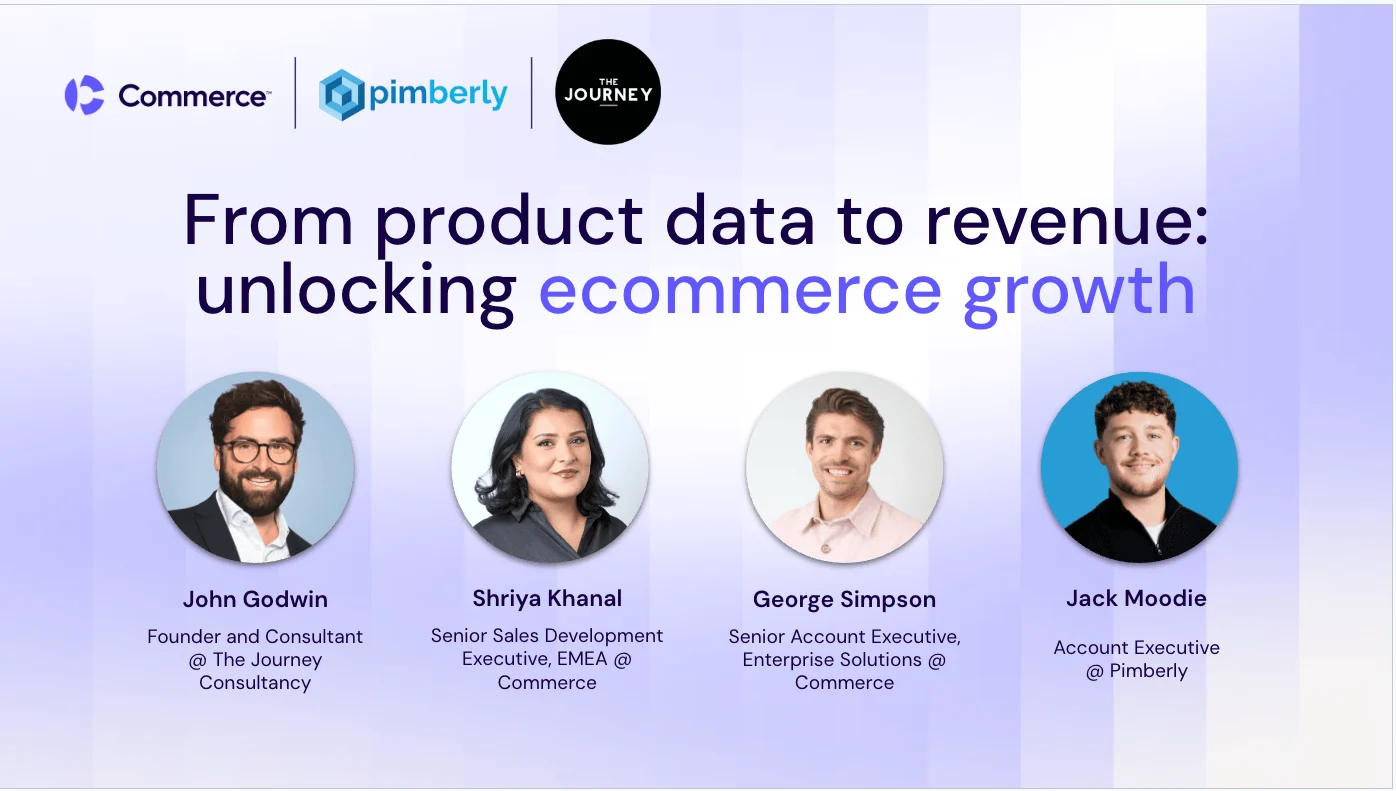
At the Fall 2026 BMF Digital Forum, Commerce joined Pimberly and The Journey Consultancy for a session called “From product data to revenue: unlocking ecommerce growth.” The room was full of building materials merchants and manufacturers, but the core argument applies to any B2B brand selling complex, spec-heavy products: the biggest barrier between your catalogue and your revenue isn’t your website, your marketplace strategy, or even your AI roadmap. It’s your product data.
Product data isn’t an IT problem anymore
For years, messy product data (e.g. inconsistent specs, missing certificates, mismatched pricing scattered across a dozen systems) got filed under “something IT will eventually sort out.” New research from MRA Research for Pimberly suggests why that persists: 98% of senior leaders in UK builders’ merchants and building materials manufacturers are confident in their product data quality, yet only 20% call their business very digitally advanced.
The confidence comes from the people furthest from the customer. Just 25% of Commercial respondents are completely confident their data is accurate, against 54% of IT and technology respondents. Yet product data ownership sits with Data or IT at 45% of businesses, Commercial at 10%, and eCommerce/Digital at just 5%. The teams who feel the commercial consequences don’t own the data, and the teams who own it feel fine. That’s how a revenue problem ends up treated like a ticket in someone’s backlog.
The bill for bad data
The same research puts a number on what that actually costs.
34% of businesses have lost or missed sales directly because of poor product data.
When a buyer can’t get a clear answer on stock, spec, or price while shopping online, they don’t call to clarify, they quietly buy from whoever can.
92% say they’re dealing with at least one product data problem. That makes it the sector norm, not an outlier, and most of those businesses are paying for it in time or sales.
On average businesses spend 26 hours a week managing and fixing product data.
That’s roughly the annual cost of one full-time employee.
70% of merchants, versus 45% of manufacturers, say data scattered across systems is their single biggest headache.
The more systems a product record passes through, the more places it can go wrong.
AI is the new front door to your catalog
That’s before accounting for the newest channel most B2B brands aren’t measuring yet: AI. Visa’s 2026 Global Digital Shopping Index finds that 48% of global consumers now use AI to help find products and shop online, and an estimated 15% of AI queries already carry shopping intent.
That changes what being findable means. Search engine optimisation (SEO) is about ranking on a results page. Its AI equivalent, generative engine optimisation (GEO), is about whether an AI can read your data well enough to recommend you. AI systems need far more structured data than a traditional search engine ever did (some estimates say up to 60 times more), so thin, inconsistent or PDF-locked product data can make you invisible to the tools your buyers are starting to ask first.
A live demo at the forum made this concrete. A generic AI search for a fire door returned nothing but “contact the supplier directly” and “verify the certificate yourself”. This isn’t because the retailer didn’t stock the product, but because the AI had no structured way to prove it. After the same product data was enriched, the identical question returned the exact product name and code, live stock count, the linked compliance certificate, trade pricing, and an accurate delivery estimate. Same product, same stock, same supplier — the only thing that changed was whether the data was structured enough for the AI to hand it over.
The size of the prize
For a sense of how much headroom is on the table: UK construction currently takes just 7% of sales online, against a realistic sector benchmark of 15–25%, and 59.4% among merchants who get the fundamentals of product data right. Whatever your vertical, the gap between “sector average” and “digital-first leader” is rarely a platform problem. It’s a data maturity problem.
Three steps to start this week
You don’t need a full data transformation program to start closing that gap:
Ask one customer what they couldn’t find. Next time one calls or drops in, ask what they couldn’t get a straight answer on last time. Was it a stock check, a spec, a delivery date or something else? Then run two tests:
Call your own branch with a stock or spec question and check your website to see if it gives the same answer.
Search for your own product the way a buyer would, on ChatGPT or Perplexity, and see what comes back.
Unlock your data. Bring specs and compliance detail out of PDFs and portals and into structured, on-site content — comparison tables, FAQs, and schema markup that let search agents actually read your ratings, materials, and use cases.
Enrich the channels you already pay for. Real-time syndication of price, stock, and availability, plus deeper attribute data, makes sure Google Ads, Meta, marketplaces, and AI crawlers never recommend something that’s out of stock — or recommend a competitor instead.
Where to start
Bad product data has always cost B2B brands sales quietly, one unanswered question at a time. AI hasn’t created that problem, it’s just made it visible in a channel most teams aren’t watching yet. To see where your own data stands, take Commerce’s Digital Maturity Assessment for a clear picture of your readiness for agentic commerce, and where to focus first.
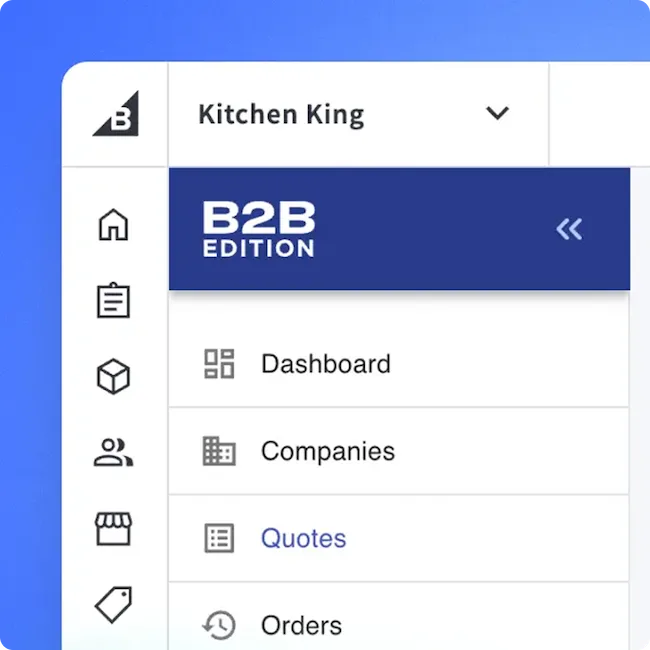
We're serious about B2B.
BigCommerce B2B Edition gives you account management and quoting tools to help your sales team get more orders.