- Start & Build

Product Overview
What you can do with BigCommerce.
Agentic Commerce
 AI-powered solutions for growth.
Design Your Store
Build your store with or without code.
Apps & Integrations
Over 1,200 apps to help you grow.
Migrate to BigCommerce
Switch from Shopify, Woocommerce, Salesforce, Magento, and more.
- Launch Services
Overview
Chart your path to success with specialised services.Implementation Project Management
Experts to ensure you launch on time and under budget.Solution Architecture
Seasoned advisors to help you best design your store.Data Migration & Optimisation
Expertise on a clean and clear path to migrating your data.Enterprise Launch Package
Personal training on how to set up and launch your BigCommerce Store.

Professional Services Blog Series
Get to know our teams and how they support your success in this Q&A series.


Your Omnichannel Strategy is Only as Strong as Your Data: What Fjällräven Learnt Building for AI Discovery
Create your store and start selling today.
Create your new website.
See if the BigCommerce platform is a good fit for your business.
No credit card required.

Written by
Mandy Spivey23/07/2026
Key Highlights
Product data is your beacon. As discovery shifts to AI, your data is the biggest lever you control, and what agents read to recommend you.
Break the marketing and ecommerce silos. Performance data and PIM data can't stay separate; closer teams move faster on AI discoverability.
Enrich at scale without losing your voice. Brand guidelines plus a human-in-the-loop scoring system keep tone consistent across thousands of SKUs.
One governed feed, every destination. A single source of truth serves structured attributes for Google and conversational context for AI alike.
Start small, measure what matters. A 100-SKU test and a multi-metric framework prove the signal before you scale.
In the age of AI agents, your product data is so much more than a back-office asset. It's a direct line to your customers.
Gaps in that data can quietly block your products from surfacing across marketplaces, search engines, and the emerging wave of agentic and answer-engine surfaces. Miss the context an AI needs, and you miss the sale.
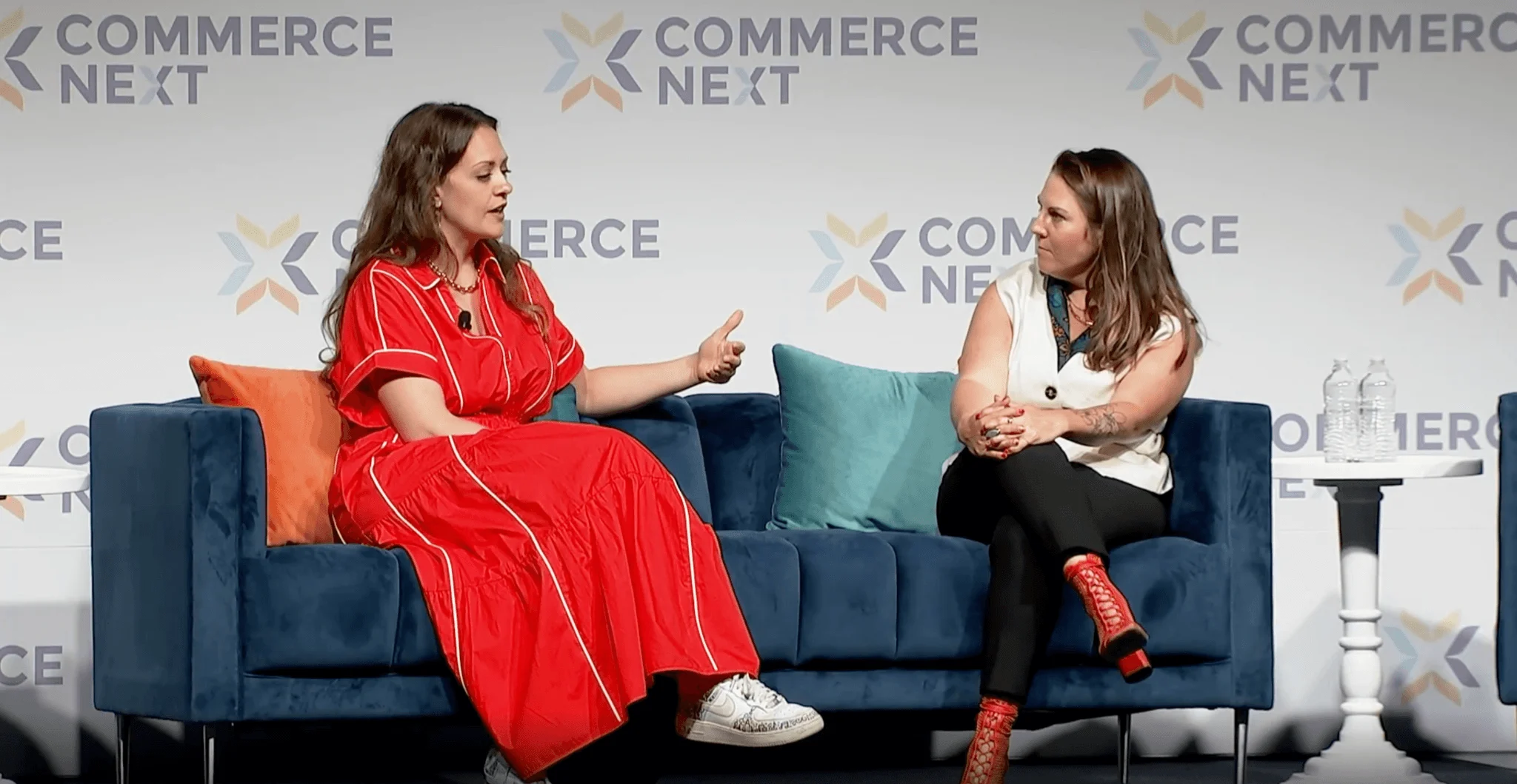
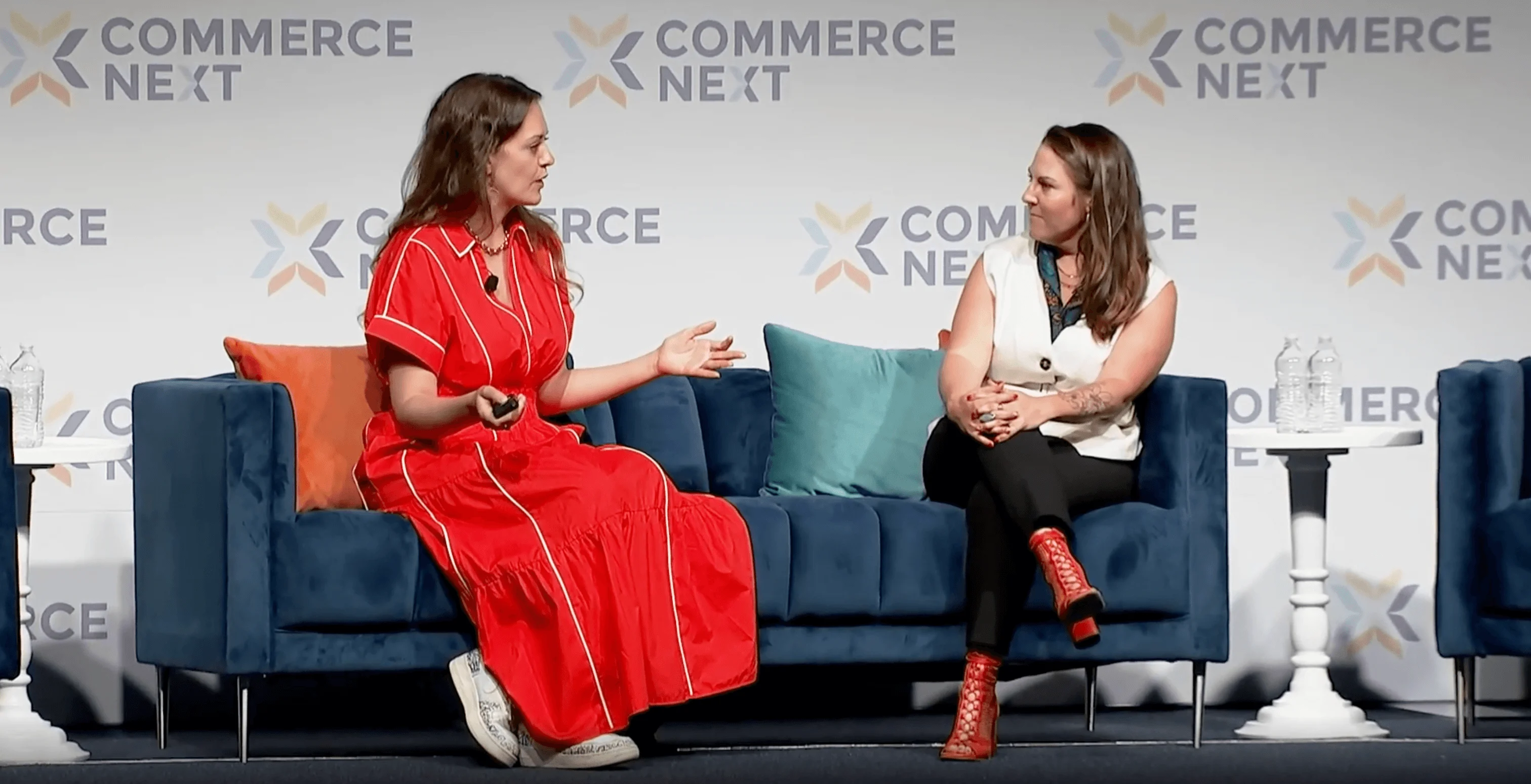
That was the premise of our CommerceNext session in the Omnichannel Transformation Track, where Feedonomics' Sharon Gee sat down with Amanda Carrew, Global Director at Fjällräven Outdoor. Amanda oversees a growth org spanning paid media, email, ecommerce, and customer service — across Fjällräven and four sister brands.
That rare, unified vantage point gave her a front-row seat to a problem more and more brands are running into: as organic discovery shifts to AI, your product data becomes the single biggest lever you actually control.
Here are the takeaways.
Product data is your beacon
Amanda's framing stuck with the room: product data is the root of everything, and in an agentic world, it's your beacon — the thing you can actually steer.
Her reasoning was pragmatic. Organic traffic is declining, and paid can't (and shouldn't) backfill that gap forever. So where does a brand regain leverage? In the data that now feeds the LLMs and agents answering customer questions.
“Our product data is like your beacon. What you have to start with.”
— Amanda Carrew, Global Director at Fjällräven Outdoor
If organic is down and paid isn't a sustainable patch, the data becomes the signal you invest in to take back a measure of control, because that's what agents read when they decide whether to recommend your brand.
The silos are showing and unified teams win
One of the clearest patterns Feedonomics sees across customers: the teams that own performance data and the teams that own the PIM historically haven't had to talk much. In an AI-driven world, that's a liability. The data feeding third-party channels and the data feeding your product catalogue now need to be consistent and far richer in context.
Fjällräven is set up in a way that helps here, with an interesting twist. At many companies, ecommerce owns the PIM. At Fjällräven, marketing owns it. Amanda's background makes that work: a master's in data science paired with a marketing career gives her the ability to read the tea leaves in the data and translate them into a revenue thesis her leadership can get behind.
The lesson for everyone else: the closer your marketing and ecommerce data functions sit, the faster you can move on AI discoverability.
Consistency and brand control go hand in hand
With thousands of SKUs, Fjällräven came to the table with what Sharon called a “grade-A feed.” But even strong data carries years of drift, which includes inconsistent brand tonality and accuracy accumulated across a catalogue built over more than a decade.
For a brand that guards its voice carefully, enrichment raises an obvious fear: will this change how people talk about us?
The answer was to keep a human firmly in the loop. To do this, Fjällräven fed its brand guidelines into the enrichment process, iterated with its own copy and brand teams, and used a scoring system to approve outputs, with checks and balances at every step.
Amanda's favourite example says it all:
“One of my copywriters said, ‘We don't use the word cozy.’ And I said, ‘Okay, well then change it.”
With enrichment rules in place, “don't use cozy” becomes a governed instruction the system applies at scale — and, just as importantly, a way to clean up the historical data so brand tonality is finally consistent across the whole catalogue. AI does the heavy lifting; humans keep the guardrails.
Every channel speaks a different language
A single feed has to serve many destinations, and each one needs something different. Google Merchant Center historically wanted structured attributes. AI discovery is a different game entirely; it's about giving an AI the context to answer a natural-language, conversational query.
That's why enrichment has to handle both structured and unstructured data, and why the data pipeline has to dynamically shape itself to each destination's schema while staying consistent underneath. On the Feedonomics side, this meant real engineering investment, including working with the Google team on universal commerce protocol, to prepare for a world with not just shoppers and merchants, but shopper agents and merchant agents, each needing data in new ways.
The goal isn't to optimise one channel. It's to build a data foundation that can enrich data for any channel — your PDPs, Google, marketplaces, and agentic surfaces — from one governed source of truth.
Start small, then measure what matters
Fjällräven's approach is a model for how to "eat the elephant." Rather than trying to eat it all at once, the team took a bite-sized test: 100 parent SKUs, in the US, on Google feeds only. No PDP changes and no marketplaces, just enough of a sample to see whether enrichment moved the needle.
The hard part wasn't the enrichment, but measurement. As Amanda put it, there's no established benchmark and no playbook for tracking AI visibility yet. So the teams built one together — what she called "the stool," a multi-legged measurement approach combining:
LLM visibility and citation scoring (using Profound)
Paid metrics
Organic metrics
They set shared baselines with the Feedonomics team based on what's being seen across the market, then gave the test three months to prove out. On just 100 SKUs, the organic lift was marginal — exactly as expected at that scale — and enough of a signal to justify expanding across the full catalogue.
Discovery first, checkout later
Agentic checkout gets the headlines, but Amanda was clear about where the real opportunity is right now: discoverability. Consumers aren't yet handing agents their credit cards en masse, but they are asking AI conversational questions and trusting the answers.
Her north star:
“I want someone typing, ‘I want a pair of hiking pants that will take me to Patagonia in the middle of summer’ — and we're the first result.”
That's the phase most brands should focus on: getting the data right so you show up, with the right information, when a customer describes their trip or their trail in their own words. The purchase rails will mature, but the brands that win when they do will be the ones already discoverable today.
Your Commerce next steps
Amanda closed with practical advice for anyone starting their LLM visibility journey:
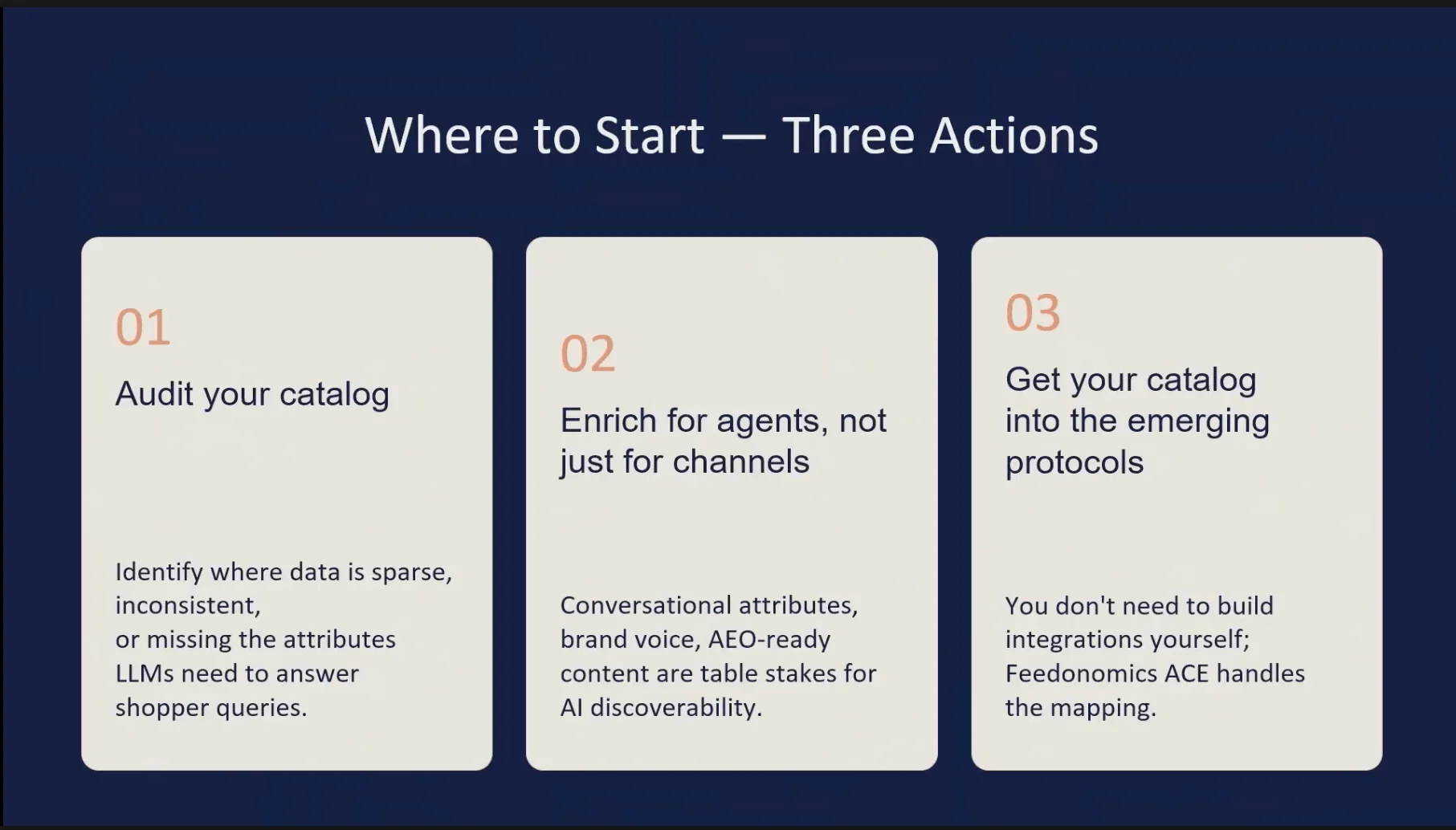
Audit your catalogue. Look at what data is going in and how you're speaking to each channel. Remember, it's no longer just structured data. It's unstructured, intent-rich, conversational content too.
Build the business case, consumer-first. When leadership asks, “What are we doing with AI?”, lead with a consumer-facing, revenue-driving test before tackling internal change management. Show impact where it hits the top line.
Take one small step. Understand your current visibility, pick a bite-size test, prove it out, and expand to the full catalogue, then to other brands and markets.
As Amanda put it: your brand is out there for consumers to discover and buy. The question is whether your data is ready to meet them where they are now.
Ready to make your catalogue discoverable everywhere AI is looking?
Data enrichment is how you show up — consistently and in context — across every search engine, marketplace, and AI tool your customers use. See how Feedonomics can help you get there and explore AI data enrichment.
Discover How AI is Transforming the Customer Experience
AI is quickly reshaping the landscape of ecommerce. Learn how you can prepare for the next wave of AI commerce.